
MUTCD-Compliant Pedestrian Crossing Signs for Roads, Parking Lots, and Shared-Use Paths
Correct crosswalk sign placement is one of the most critical factors in pedestrian safety. A sign installed too far from the crossing, at the wrong height, or facing the wrong direction provides little protection for pedestrians and little warning for drivers. This guide covers pedestrian crossing sign placement requirements drawn from MUTCD standards, explains where to install crosswalk signs across different environments, and helps you choose the right sign type and material for your application.
Common Questions About Crosswalk Sign Placement
- Does a crosswalk have to have a sign?
- Not every crosswalk legally requires a sign, but the MUTCD strongly recommends pedestrian warning signs at any crossing where driver expectation of pedestrian activity is low. Marked midblock crosswalks, crossings near schools, trail crossings, and any uncontrolled crossing on a roadway with a posted speed above 35 mph should have advance warning signs as a minimum. At signalized intersections, signs may be optional, but supplemental pedestrian crossing signs are still widely used to improve visibility.
- What are the rules for pedestrian crossings under MUTCD standards?
- The MUTCD (Manual on Uniform Traffic Control Devices) governs pedestrian crossing sign placement requirements in the United States. For warning signs such as the W11-2 pedestrian crossing sign, the standard calls for placement on the right side of the road, in advance of the crossing, at a distance appropriate to the posted speed. On roads posted at 25 mph, the sign is typically placed 100 to 200 feet in advance of the crossing. At 45 mph, that advance distance increases to 325 feet or more. Signs must be mounted between 5 and 7 feet above the pavement to the bottom of the sign, and must use retroreflective sheeting that meets MUTCD retroreflectivity standards. Fluorescent yellow-green (FYG) background color is recommended for pedestrian, bicycle, and school crossing warning signs due to its high daytime conspicuity.
- What is the spacing for crosswalk markings and signs?
- Crosswalk markings and their associated signs should work together as a system. For pavement markings, the MUTCD recommends transverse lines at least 6 inches wide and spaced no more than 12 inches apart for ladder-style crosswalks. For advance warning signs, the placement distance from the crosswalk varies by speed: approximately 100 feet at 25 mph, 175 feet at 35 mph, and 325 feet at 45 mph. When a supplemental plaque such as 'Ahead' is used, it is mounted directly below the primary warning sign. At locations with multiple sequential crossings, signs should be spaced so each crossing has its own dedicated advance warning placement.
- How do you install a pedestrian crossing sign?
- Pedestrian crossing sign installation follows a straightforward process. First, determine the correct advance distance from the crosswalk based on posted speed. Select a sign support (post, u-channel, or breakaway mounting) that meets your jurisdiction's requirements. Mount the sign on the right side of the roadway, facing oncoming traffic, with the bottom of the sign between 5 and 7 feet above the edge of the pavement. In parking lots or shared-use paths where vehicle speeds are lower, mounting height may be adjusted to a minimum of 4 feet above the walking surface. Use U-bolt or band clamps rated for the sign size, and ensure the sign panel is perpendicular to the direction of approaching traffic. All hardware should be corrosion-resistant, particularly in coastal or high-humidity environments.
- Where should pedestrian crossing signs be installed in parking lots?
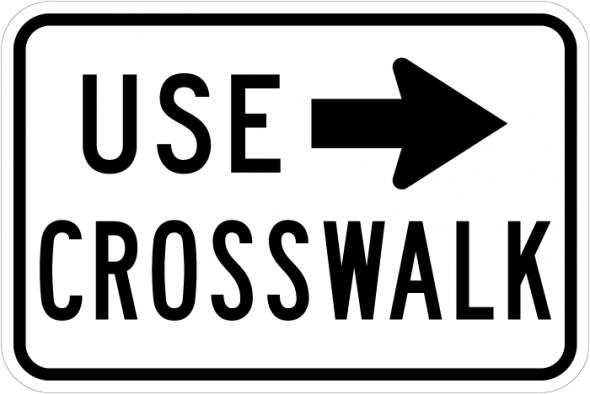
- Parking lot pedestrian signs should be placed at every marked crosswalk connecting the parking field to the building entrance, as well as at any pedestrian path that crosses a drive aisle. Signs should face oncoming vehicle traffic in the drive aisle, not pedestrians. Advance placement of 20 to 50 feet before the crosswalk is typical given the lower speeds in parking environments. A Use Crosswalk plaque or directional arrow sign can supplement the main warning sign to direct pedestrians to the marked crossing location.
- What sign sizes are required for crosswalk warning signs?
- MUTCD crosswalk sign size requirements depend on roadway classification. The standard size for the W11-2 pedestrian warning sign on conventional roads is 30 inches by 30 inches. On expressways and freeways, 36 by 36 inches is the minimum. In low-speed environments such as parking lots, residential streets, and trail crossings, a 24 by 24 inch sign may be acceptable. Larger sizes improve visibility at higher speeds and are generally recommended for any crossing on a multi-lane arterial or a road with a speed limit above 35 mph.
- What reflective material should crosswalk signs use?
- The MUTCD requires all pedestrian crossing warning signs to use retroreflective sheeting that meets or exceeds Type III high-intensity prismatic standards for most roadway applications. Diamond-grade prismatic sheeting, which exceeds Type IX performance, is the best choice for high-speed arterials, rural crossings, and any location with limited streetlighting. Engineer-grade sheeting is the entry-level option and is generally adequate only for very low-speed, well-lit environments such as private parking lots. Fluorescent yellow-green retroreflective backgrounds are permitted and recommended for W11-2 and related pedestrian warning signs because of their superior daytime conspicuity compared to standard yellow.
MUTCD Crosswalk Sign Placement Requirements Explained
Pedestrian Sign Placement by Location Type
Midblock Crosswalk Signs
Midblock crosswalks present the greatest challenge for driver expectation because they occur away from intersections where drivers are already conditioned to watch for pedestrians. MUTCD pedestrian crossing signs at midblock locations must be placed in advance of the crossing on both approaches, with the advance distance scaled to posted speed. A high-intensity or diamond-grade retroreflective sign is strongly recommended at midblock locations, particularly on arterial roads. Supplemental Ahead plaques below the primary W11-2 sign are standard practice at these locations.
Parking Lot Pedestrian Signs
Parking lots require pedestrian crossing signs at every striped crosswalk crossing a drive aisle, particularly in high-traffic retail and commercial settings. Because vehicle speeds are lower (typically 10 to 15 mph), advance placement distances of 20 to 50 feet are generally sufficient. Signs can be mounted on flexible delineator posts or standard round posts. The R9-3b Use Crosswalk plaque is a common addition to direct pedestrians to the marked crossing rather than crossing mid-aisle. For a broader look at managing traffic flow in commercial parking areas, see our parking lot traffic signs guide.
Trail Crossings and Shared-Use Path Crossings
Where a shared-use path crosses a roadway, the crossing must be signed from both the road and path perspectives. From the roadway approach, a W11-15 Bicycle and Pedestrian Crossing sign with an Ahead plaque alerts drivers. From the path, a stop or yield sign for path users, along with a supplemental crossing information sign such as the R9-7 Shared Use Path Restriction Sign, helps manage conflicts between cyclists and pedestrians approaching the road crossing.
School Crossing Signs
School crossing sign placement follows specific MUTCD guidance under the S-series supplements. The standard school crossing advance warning sign (S1-1) is placed in advance of the crossing with fluorescent yellow-green background. Crossing signs should be supplemented with school speed limit signs and pavement markings during school hours.
Custom and Non-Standard Crossing Locations
For crossings that do not fit a standard template, such as mid-block crossings through landscaped medians, angled crossings, or crossings at private driveways, custom reflective aluminum signs allow facilities managers to communicate exactly the right message with the correct retroreflective material and shape.
Choosing the Right Sign Size for Your Crosswalk Location
Crosswalk Sign Reflective Material Comparison
Selecting the correct reflective sheeting grade is as important as correct placement. The table below compares the three grades available on aluminum crosswalk and pedestrian warning signs from Trafficsigns.com, based on their performance characteristics and typical applications.
| Feature | Engineer Grade | High Intensity | Diamond Grade |
|---|---|---|---|
| MUTCD Designation | Type I / II | Type III / IV | Type IX / XI |
| Retroreflectivity Level | Standard | Very High | Ultra High |
| Best For | Private lots, low-speed paths | Local roads, parking areas, trail crossings | Arterials, highways, unlit midblock crossings |
| Nighttime Visibility | Good | Very Good | Excellent |
| Daytime Conspicuity | Standard | High | Highest |
| Typical Outdoor Lifespan | 7+ years | 10+ years | 12+ years |
| FYG Background Available | Yes | Yes | Yes |
| Starting Price (24x24) | ~$55.95 | ~$65.95 | ~$89.95 |
Crosswalk and Pedestrian Crossing Signs
 Regulatory Pedestrian Signs
Use Crosswalk (Plaque) Sign - R9-3b
$21.95 - $92.50
Shop on Trafficsigns.com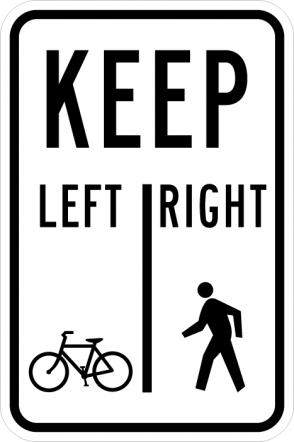 Regulatory Pedestrian Signs
Shared Use Path Restriction Sign - R9-7
$21.95 - $58.25
Shop on Trafficsigns.com Regulatory Pedestrian Signs
Pedestrian Crossing Sign - W11-2
$44.25 - $176.60
Shop on Trafficsigns.com Regulatory Pedestrian Signs
Pedestrian Crossing Stop Sign - R1-6a
$29.26 - $33.25
Shop on Trafficsigns.com Regulatory Pedestrian Signs
Pedestrian Crosswalk Sign - R9-8
$49.75 - $86.25
Shop on Trafficsigns.comReady to Order Crosswalk and Pedestrian Crossing Signs?
Trafficsigns.com stocks and custom-manufactures MUTCD-compliant pedestrian crossing signs in engineer grade, high intensity, and diamond grade reflective aluminum. Order standard signs or configure a custom sign with your specific message, size, and reflective grade. Bulk pricing is available for municipalities, contractors, and property managers ordering multiple signs.
Shop Pedestrian Safety Signs