
The MUTCD W20-2 DETOUR sign that tells drivers exactly when and where a detour begins
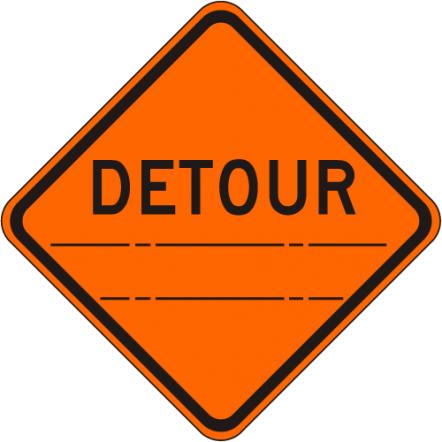
A detour 1000 ft sign gives drivers critical lead time before they reach a rerouted section of roadway. Under the MUTCD, it's the DETOUR (W20-2) sign: an orange diamond that reads DETOUR with a distance line underneath, such as 1000 FEET, so drivers know exactly how far ahead the change in travel path begins. Posted in advance of construction zones, road closures, and special events, it reduces sudden lane changes, confusion, and crashes. Trafficsigns.com stocks the Detour (distance) Sign - W20-2 along with the rest of a standard detour sequence, from reflective aluminum panels to roll-up signs for mobile and short-duration work.
Common Questions About Buying Detour 1000 Ft Signs
- What is a detour 1000 ft sign and when do I need one?
- A detour 1000 ft sign is the MUTCD DETOUR (W20-2) sign with a 1000 FEET distance line, posted in advance of a detour so drivers know a rerouted path is 1,000 feet ahead. The MUTCD calls for the W20-2 in advance of any detour onto a different road or route, and the distance line can also read AHEAD or a distance in miles. Crews installing temporary traffic control for construction, utility work, or road closures use it alongside ROAD CLOSED signs and the detour arrow signs that guide drivers along the new route.
- Is a detour sign considered a warning sign under MUTCD?
- Yes. The DETOUR (W20-2) sign is a warning sign in the MUTCD's W20 series for temporary traffic control. Like other work zone warning signs, it's a diamond with a black legend on an orange background, and it must be retroreflective or lit for nighttime use. The signs that guide drivers along the route itself, like the Detour with Arrow - M4-9 and Detour Arrow (M4-10) signs, are rectangular black-on-orange guide signs.
- What materials are detour signs made from and how long do they last outdoors?
- Detour signage is available in reflective aluminum for longer-term installations, and in roll-up material for short-duration or mobile work zones. For orange work zone signs, choose High Intensity or Diamond Grade sheeting, since the MUTCD doesn't allow Engineer Grade on orange signs. Aluminum signs typically hold up for 7 to 10 years or more outdoors, while roll-up signs are built for repeated setup and takedown over a project's lifespan.
- What sizes are available for a detour sign?
- The Detour (distance) Sign - W20-2 comes in 24, 30, 36, and 48 inch diamonds, and the Detour Ahead Roll-Up - W20-2-RU comes in 36x36 and 48x48. Larger sizes are used on higher-speed roads where drivers need to see the message from farther away. The MUTCD sets sizes for work zone signs by road type, so check those sizes and your state DOT or local agency requirements before ordering.
- How much do detour signs cost and are bulk discounts available?
- Pricing varies by size, material, and reflectivity grade. Detour Arrow (M4-10) signs start around $19.95, the Detour with Arrow (M4-9) starts at $57.95, and the W20-2 DETOUR sign starts at $44.25, with larger High Intensity or Diamond Grade versions and roll-up signs running higher. Most products on our site include volume pricing tiers that lower the per-sign cost as quantity increases, which is useful for contractors managing multiple work zones at once.
- How are detour 1000 ft signs installed on a roadway or job site?
- Aluminum detour signs mount to U-channel posts, square tube posts, or portable sign stands using standard punched holes. On post-mounted signs in work zones, the MUTCD calls for the bottom of the sign to be at least 7 feet above the ground in urban areas and at least 5 feet in rural areas, and signs on portable supports should be at least 1 foot above the road. Roll-up signs attach to lightweight stands for quick setup and breakdown each shift, which makes them practical for short-term lane closures and moving operations. Check with your state DOT or local agency for any additional placement requirements.
- How should I store detour signs between projects?
- Aluminum signs should be stacked flat or stored vertically in a dry area away from direct sun to preserve reflective sheeting. Roll-up signs fold into their designed storage shape and should be kept in a case or bag to avoid creases and dirt buildup, keeping them ready for the next temporary traffic control setup.
What Is a Detour 1000 Ft Sign and How Does It Work?
A detour 1000 ft sign is the MUTCD DETOUR (W20-2) sign, an orange diamond with DETOUR on the top line and a distance like 1000 FEET below it. Instead of leaving drivers guessing how far away the rerouted path is, the sign spells it out in plain numbers. This makes a big difference in driver behavior, especially on roads with higher travel speeds where sudden braking or last-second lane changes create real hazards.
The W20-2 is one piece of a standard detour sequence used in temporary traffic control. Crews setting up work zones, detours around bridge repairs, or event-related closures rely on a layered approach: the DETOUR 1000 FEET sign first, a ROAD CLOSED sign at the closure point, Detour Arrow and Detour with Arrow signs at each turn along the route, and an END DETOUR sign where drivers rejoin their original route. For a broader look at how warning signs fit into the full sign system, see our breakdown of common types of traffic signs.
MUTCD Detour Sign Requirements and Placement Guidelines
The DETOUR (W20-2) sign is part of the MUTCD's W20 series of temporary traffic control warning signs. Like other work zone warning signs, it's diamond-shaped with a black legend and border on an orange background, and any sign used at night must be retroreflective or lit. The MUTCD calls for the W20-2 in advance of any detour onto a different road or route. For spacing, the MUTCD gives guidance rather than fixed rules: the advance warning area can be as short as 100 feet on low-speed residential streets, while rural highways typically need 1,500 feet or more, adjusted for field conditions. That's why a 1000 FEET distance line is a common choice on higher-speed roads.
Placement also depends on mounting height and lateral offset from the travel lane. For post-mounted work zone signs, the MUTCD calls for the bottom of the sign to be at least 7 feet above the ground in urban areas and 5 feet in rural areas. Check with your state DOT or local agency for any additional placement requirements. For crews managing active work zones, our temporary traffic control resources outline full sign sequencing, from the first warning sign through the final detour direction marker. Reflectivity grade matters too. The MUTCD doesn't allow Engineer Grade on orange signs, so choose High Intensity or Diamond Grade sheeting, which also hold up better in low-light and nighttime conditions, which is covered in more depth in our guide to reflective traffic signs.
Detour Straight, Left, and Right Signs: Choosing the Right Configuration
Once drivers pass the DETOUR 1000 FEET sign, they need clear direction at every point where the route changes. The MUTCD uses its own detour signs for this, all with a black legend on an orange background. The Detour with Arrow - M4-9 shows the word DETOUR with an arrow pointing left, right, or straight ahead, and it's the main sign posted at each turn along the detour route.
Where a detour route has been established, the Detour Arrow sign adds a simple, bold arrow that drivers can spot quickly. The Detour Arrow Left - M4-10L and Detour Arrow Right - M4-10R come in 48x18 and 24x8 sizes. When the detour follows a numbered route, a DETOUR plaque can be mounted on top of the route sign instead. At the end of the detour, an END DETOUR sign or plaque tells drivers they're back on their original route, which completes the sequence and keeps drivers from second-guessing where to go.
Detour Sign Comparison
Here's how the core detour signs in a standard MUTCD detour sequence compare in terms of use case, sizing, and material options.
| Product | Best For | Standard Sizes | Material Options | Price Range |
|---|---|---|---|---|
DETOUR (distance) Sign - W20-2 | Advance warning of a detour, with a distance line like 1000 FEET | 24", 30", 36", 48" diamond | High Intensity or Diamond Grade (Engineer Grade isn't allowed on orange signs) | $44.25 - $256.95 |
Detour Ahead Roll-Up - W20-2-RU | Short-duration or mobile work zones needing quick setup and takedown | 36x36, 48x48 | High Intensity or Diamond Grade for night use; non-reflective and mesh for daytime-only work | $44.55 - $213.75 |
Detour with Arrow - M4-9 | Marking each turn or straight-through point along the detour route | 30x24 | High Intensity or Diamond Grade | $57.95 - $92.50 |
Detour Arrow Left - M4-10L | Guiding drivers left along an established detour route | 48x18, 24x8 | High Intensity or Diamond Grade | $19.95 - $111.95 |
Detour Arrow Right - M4-10R | Guiding drivers right along an established detour route | 48x18, 24x8 | High Intensity or Diamond Grade | $19.95 - $111.95 |
Detour Signs for Temporary Traffic Control
Build a complete MUTCD detour sign sequence, from the DETOUR 1000 FEET warning sign to the arrow signs that guide drivers along the route, in reflective aluminum or roll-up versions.
 Warning Signs > Construction Signs
Detour (distance) Sign - W20-2
DETOUR with a distance line like 1000 FEET
$44.25 - $256.95
Shop on Trafficsigns.com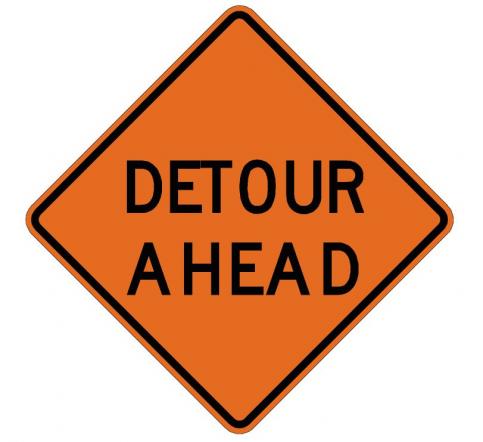 Warning Signs > Construction Signs
Detour Ahead Roll-Up Construction Signs - W20-2-RU
$44.55 - $213.75
Shop on Trafficsigns.com Warning Signs > Construction Signs
Detour with Arrow - M4-9
$57.95 - $92.50
Shop on Trafficsigns.com Warning Signs > Construction Signs
Detour Arrow Left Signs - M4-10L
$19.95 - $111.95
Shop on Trafficsigns.com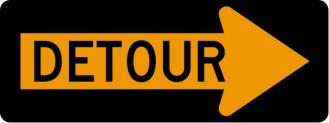 Warning Signs > Construction Signs
Detour Arrow Right Signs - M4-10R
$19.95 - $111.95
Shop on Trafficsigns.comBuild a Complete Detour Sign Sequence Today
From the DETOUR 1000 FEET sign to roll-up panels and detour arrow signs, Trafficsigns.com carries the signs you need for a standard MUTCD detour sequence on your next temporary traffic control project. Order the signs you need and keep drivers moving safely around work zones, closures, and reroutes.