
Why a 65 mph highway needs a bigger sign than a 25 mph neighborhood street
Traffic sign size is not a one-size-fits-all decision. The faster traffic moves, the less time drivers have to spot, read, and react to a sign. That is why the Federal Highway Administration's Manual on Uniform Traffic Control Devices (MUTCD) sets standard sign sizes by road type (conventional roads, expressways, and freeways) and by the number of lanes, with larger sizes on the faster, wider roads. This guide breaks down how road type, speed, and legibility determine traffic sign dimensions, so you can select correctly sized regulatory, warning, and guide signs for local roads, arterials, and highways.
Traffic Sign Size Questions Buyers Ask Most
- What is the standard size for a traffic sign?
- It depends on the sign and the road. Under the MUTCD 11th Edition (Table 2B-1 for regulatory signs and Table 2C-1 for warning signs), a stop sign is 30" x 30" on a single-lane conventional road, a speed limit sign is 24" x 30", and most diamond-shaped warning signs are 30" x 30". Sizes step up on multi-lane roads, where diamond warning signs must be at least 36" x 36", and again on expressways and freeways, where a speed limit sign runs 36" x 48" or 48" x 60".
- How big is a 2x2 sign?
- A '2x2' traffic sign measures 24 inches by 24 inches. In the MUTCD, 24" x 24" appears in the Minimum size column for certain warning signs, such as intersection warning signs. The MUTCD limits Minimum sizes to low-speed roads, alleys, and private roads open to public travel, or to locations where physical conditions rule out a larger sign. On most public streets, the standard size for these warning signs is 30" x 30".
- What size should a road sign be for my street or property?
- Start with the road type and the number of lanes, then check the MUTCD size tables for the specific sign. On a typical local street with one lane in each direction, that means 30" x 30" for stop signs and most diamond warning signs and 24" x 30" for speed limit signs. Multi-lane roads call for larger sizes, such as a 36" x 36" stop sign or warning sign. Smaller Minimum sizes, such as an 18" x 24" speed limit sign, are reserved for low-speed roads, alleys, and private roads open to public travel. You can browse sizing options by category on our regulatory signs and speed limit signs pages to match your specific road conditions.
- How big is a normal traffic sign?
- On most U.S. local streets, a typical traffic sign falls between 24" x 30" and 36" x 36". A standard speed limit sign is 24" x 30", while stop signs and most diamond warning signs are 30" x 30" on single-lane roads and 36" x 36" on multi-lane roads. Expressway and freeway signs run larger, such as a 36" x 48" or 48" x 60" speed limit sign, to stay legible at higher travel speeds.
- What material and reflectivity grade should I choose for larger, high-speed signs?
- For signs posted along roads with speeds of 45 mph or higher, we recommend high intensity or diamond grade reflective aluminum rather than engineer grade. These grades reflect more light back to headlights at greater distances, which matters more as sign size and travel speed increase. All grades are reflective aluminum on standard punched blanks. Our high intensity and diamond grade signs are manufactured to MUTCD specifications, which makes them the right choice for regulatory and warning signs on public roads. Engineer grade signs are a cost-effective option for low-speed private drives, interior lots, and pedestrian areas. Retroreflectivity requirements vary by state and local jurisdiction, so confirm what applies to your road before ordering.
- Does traffic sign size affect price, and are bulk discounts available?
- Yes. Larger sign dimensions and higher reflective grades both increase per-unit cost. For example, a 24" x 12" engineer grade sign starts around $22, while the same design in a 48" x 24" diamond grade finish runs over $120. Most products offer tiered bulk pricing, with unit costs dropping at order quantities of 4, 7, 16, and 50 signs, which is worth factoring in for multi-sign installations like highway corridors or subdivisions.
- Do larger highway traffic signs need different mounting or posts?
- Yes. As sign size increases, wind load and weight increase as well, so 36" and 48" signs typically require heavier-gauge posts, additional mounting hardware, or dual-post installations compared to a standard 24" sign on a single u-channel post. Always confirm mounting height and post spacing against your state DOT specifications before installation, especially for high-speed roadway applications.
How Driving Speed Determines Traffic Sign Size
Traffic sign visibility depends on a simple relationship: the faster a vehicle travels, the more distance a driver needs to notice a sign, read its message, and respond safely. The MUTCD accounts for this in two ways. Its size tables (Table 2B-1 for regulatory signs and Table 2C-1 for warning signs) step sign sizes up from conventional roads to expressways and freeways, and from single-lane to multi-lane roads. Separately, Table 2C-3 uses posted or 85th-percentile speed to set how far ahead of a hazard a warning sign should be placed.
On a residential street posted at 25 mph, a driver covers roughly 37 feet per second, giving them a reasonable window to spot and process a standard 30" x 30" warning sign. On a rural highway posted at 65 mph, that same driver covers about 95 feet per second, cutting reaction time dramatically. To compensate, the MUTCD calls for larger signs on multi-lane roads, expressways, and freeways (at least 36" x 36" for most diamond warning signs), agencies often choose oversized signs on high-speed two-lane highways, and reflective sheeting grades typically move up from engineer grade to high intensity or diamond grade to maintain nighttime visibility at distance.
This is why you'll see larger traffic signs concentrated on state routes, expressways, and interstate corridors, while smaller standard sizes remain common on local streets and parking areas. Roads with a mix of speeds, such as a highway approaching a town, will often show a stepped sizing pattern where signs get progressively larger as posted speeds increase toward the open highway. For applications like this, our highway warning signs collection is built around these larger, high-speed sizing requirements.
Standard Traffic Sign Sizes by Category and Road Type
The MUTCD lists sign sizes sign by sign: Table 2B-1 covers regulatory signs and Table 2C-1 covers warning signs. Each table gives sizes for single-lane and multi-lane conventional roads, expressways, and freeways, plus Minimum and Oversized columns. Minimum sizes are limited to low-speed roads, alleys, and private roads open to public travel, or to locations where physical conditions rule out a larger sign.
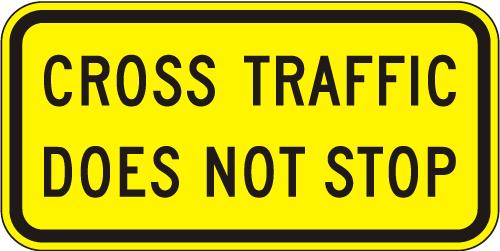
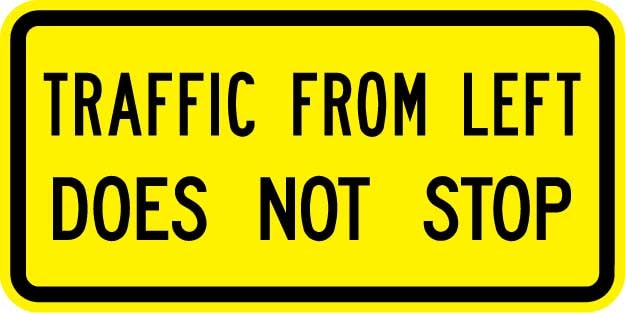
Regulatory signs, which include stop signs, speed limit signs, and restriction signs like No Driving On Shoulder - R4-17, each have their own sizes in Table 2B-1. A stop sign is 30" x 30" on single-lane conventional roads and 36" x 36" on multi-lane roads and expressways, and 30" x 30" is also its minimum size. A speed limit sign is 24" x 30" on single-lane roads, 30" x 36" on multi-lane roads, 36" x 48" on expressways, and 48" x 60" on freeways. Warning signs, which alert drivers to upcoming hazards like curves, intersections, or non-standard traffic patterns, follow a similar pattern. Most diamond-shaped warning signs are 30" x 30" on single-lane conventional roads, and Section 2C.03 requires diamond warning signs facing traffic on multi-lane conventional roads to be at least 36" x 36". Expressway and freeway sizes run 36" x 36" to 48" x 48". The smaller 24" x 24" size appears only in the Minimum column for certain signs, such as intersection warning signs. Our road condition warning signs line also includes plaques indicating that cross or oncoming traffic does not stop, which mount below a stop sign. They come in the 24" x 12" conventional-road size and the 48" x 24" oversized size listed for them in Table 2C-1.
Guide signs and highway markers, like county route markers, often use different width-to-height ratios and can run considerably larger than regulatory or warning signs because they need to communicate more information (route numbers, destinations, distances) at highway speeds. If you're specifying blank aluminum for a custom or oversized installation, our sign blanks inventory covers the punched aluminum substrates used across all these standard sizes.
MUTCD Traffic Sign Sizes by Road Type
Use this reference to match common signs to your road. Sizes come from the MUTCD 11th Edition, Table 2B-1 (regulatory signs) and Table 2C-1 (warning signs), and are shown as width x height. Smaller Minimum sizes, such as an 18" x 24" speed limit sign, are limited to low-speed roads, alleys, and private roads open to public travel. Always confirm exact requirements with your state DOT, since some states adopt their own MUTCD supplement with additional requirements.
| Road Type | Stop Sign (R1-1) | Speed Limit Sign (R2-1) | Curve Warning Signs (W1-1 to W1-5) |
|---|---|---|---|
| Conventional road, one lane in each direction | 30" x 30" | 24" x 30" | 30" x 30" |
| Conventional road, multi-lane | 36" x 36" | 30" x 36" | 36" x 36" |
| Expressway | 36" x 36" | 36" x 48" | 36" x 36" |
| Freeway | Not used on freeways | 48" x 60" | 36" x 36" |
Traffic Signs Sized for Every Road Type
These signs are available in multiple standard dimensions and reflective grades, so you can match sign size to your road type and number of lanes.

 Warning Signs
Traffic From Left Does Not Stop Sign - W4-4A
$22.10 - $123.75
Shop on Trafficsigns.com
Get the Right Sign Size for Your Road
Whether you're outfitting a residential cul-de-sac or a state highway corridor, sizing your traffic signs correctly is a matter of safety and compliance, not guesswork. Browse our full range of regulatory and warning signs to find the standard size, reflective grade, and price point that fits your road type and number of lanes.