
Understand private road signage requirements, MUTCD compliance, and enforcement options for HOAs, neighborhoods, and private property owners.
Common Questions About Private Road Sign Requirements
- Are private roads required to follow MUTCD sign standards?
- The Manual on Uniform Traffic Control Devices (MUTCD) technically applies to roads open to public travel. Strictly private roads with no public access are not legally required to follow MUTCD standards under federal law. However, many states and local jurisdictions extend MUTCD requirements to privately owned roads that carry public or semi-public traffic, such as HOA streets, apartment complex roads, and gated community entrances. Beyond legal requirements, using MUTCD-compliant private road traffic signs is a best practice because it ensures sign colors, sizes, and symbols are universally understood by drivers. It also strengthens your liability position if an accident occurs.
- What signs are typically needed for a private road?
- The most common private road signs include a 'Private Road' or 'Private Property' identification sign at the entrance, a 'No Trespassing' sign, speed limit signs, stop signs at intersections, and 'No Thru Traffic' signs to discourage cut-through traffic. Neighborhoods and HOAs often also post 'No Outlet' or 'Dead End' markers, parking restriction signs, and neighborhood watch signs. The exact signs needed depend on road configuration, traffic volume, and the goals of the property owner or HOA.
- Can a private road speed limit sign actually be enforced?
- Enforcement of private road speed limit signs depends entirely on state law and the terms of any recorded easements or HOA covenants. In many states, local law enforcement has no authority to issue citations on private property for speed limit violations. However, private property owners can enforce compliance through civil mechanisms, HOA rules, or by contracting private security. Some states do allow police to enforce traffic laws on private roads that are open to general public use. Regardless of enforcement authority, posted speed limit signs still reduce speeds by communicating expectations clearly to drivers.
- What material should I choose for private road signs?
- Reflective aluminum is the standard material for private road signs, and it is what all signs on Trafficsigns.com are made from. Engineer Grade reflective sheeting provides good nighttime visibility for most residential private roads. High Intensity sheeting offers significantly brighter retroreflectivity and is a better choice for higher-speed roads, busy entrances, or areas with poor ambient lighting. Diamond Grade sheeting delivers maximum visibility and is used when the highest possible retroreflectivity is required. All three grades are produced on durable aluminum blanks that resist rust, fading, and weathering.
- What sizes are available for private road signs?
- Private road signs are available in multiple sizes to suit different mounting locations and road widths. Common sizes include 12x18 inches for low-speed residential settings, 18x24 inches for standard private road entrances, and 24x30 inches for higher-visibility applications or larger roads. Speed limit signs for private roads typically follow the same size conventions as public road signs, with 12x18 inches being the minimum for low-traffic roads and 18x24 or 24x30 inches for busier private streets. Choosing the right size ensures the sign is readable at the approach speed of the road.
- Do HOA traffic signs need to meet any specific standards?
- HOA traffic signs are not universally subject to MUTCD requirements unless state law or local ordinance specifically requires it. That said, using MUTCD-compliant designs for HOA traffic signs is strongly recommended. Standard colors, fonts, and symbols ensure drivers respond to the signs correctly and help the HOA demonstrate reasonable care in managing road safety. Many HOA governing documents also require that signage meet recognized standards. All signs available at Trafficsigns.com are produced to meet DOT and MUTCD standards, making them appropriate for HOA and neighborhood traffic control use.
- Can I get custom private road signs with specific text or logos?
- Yes. Custom reflective aluminum signs are available in a range of standard shapes and sizes, including vertical, horizontal, square, and diamond formats. You can specify custom text, property names, address ranges, or specific regulatory language. All custom signs are produced on reflective aluminum blanks and are available in Engineer Grade, High Intensity, or Diamond Grade sheeting. Custom signs are a practical solution when a standard catalog sign does not match the exact wording or layout your private road or HOA requires.
Do Private Roads Have to Follow MUTCD Standards?
What Signs Are Needed on a Private Road?
The entrance to any private road should clearly identify its status. A 'Private Road' or 'Private Property' sign establishes that the road is not for general public use. Pairing this with a 'No Trespassing' sign adds a legal notice that unauthorized entry is prohibited, which matters if property owners ever need to pursue trespass enforcement.
Private road speed limit signs communicate safe travel speeds to all drivers on the road, including residents, guests, and service vehicles. A posted speed limit also creates an expectation of conduct that supports enforcement through HOA rules or civil action. Standard private road speed limits range from 10 to 25 mph depending on road width, visibility, and pedestrian activity.
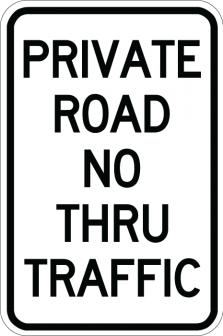
Stop signs, yield signs, and intersection warning signs manage traffic flow at internal road junctions. Without posted controls at intersections, right-of-way disputes are common and accident liability is unclear. For roads that connect to public streets, a 'No Thru Traffic' sign reduces cut-through traffic from drivers seeking shortcuts.
HOA communities and multi-unit residential roads often need parking restriction signs, no-parking zones, and reserved-space designations. These help manage curb space, emergency vehicle access, and resident parking equity.
Neighborhood crime watch signs are a low-cost, high-visibility addition to any private road signage plan. They communicate to visitors that the community is organized and observant, which deters opportunistic trespass and theft.
Are Private Road Signs Legally Enforceable?
Most local police and sheriff departments do not have authority to issue traffic citations on private property unless state law specifically grants it. States vary significantly: some allow police to enforce basic traffic laws on any road open to public travel, even if privately owned; others restrict enforcement to dedicated public roads. Property owners who need citation-level enforcement should consult with a local attorney to understand what applies in their jurisdiction.
For HOA-governed communities, traffic rules posted on private road signs can be enforced through recorded covenants and HOA bylaws. An HOA can levy fines, restrict access, or pursue civil remedies against residents or guests who repeatedly violate posted rules. The signs serve as the physical notice that the rules exist. Without clearly posted signs, enforcement actions are harder to defend.
Even outside of criminal traffic enforcement, private road signs carry real legal weight in civil liability contexts. A property owner who posts compliant speed limit signs and stop signs has taken a reasonable step to manage road safety. If a driver ignores a posted sign and causes an accident, that posted sign is evidence that the hazard was communicated. Conversely, a property owner who fails to post required or reasonable signs may face greater exposure in a negligence claim.
For trespassing and access control, the practical enforceability of private road signs starts with visibility. Reflective signs that are clearly visible day and night, properly sized for the approach speed, and positioned at logical decision points are more likely to change driver behavior than signs that are small, faded, or poorly placed. Choosing high intensity or diamond grade reflective aluminum ensures signs remain visible and legible over many years of outdoor exposure.
Sign Placement and Installation Requirements for Private Roads
MUTCD guidelines recommend mounting signs so the bottom edge is at least 5 feet above the road surface in rural areas and 7 feet in pedestrian zones. Signs should be positioned on the right side of the road in the direction of travel, facing oncoming traffic. On private roads with limited right-of-way, a minimum clearance of 2 feet from the edge of the travel lane to the near edge of the sign is practical.
Speed limit signs should be placed at the entrance to the private road and at regular intervals, particularly after intersections or access points. Warning signs for intersections should be placed far enough in advance that a driver traveling at the road's posted speed has time to slow and react. For a 15 mph private road, this typically means 50 to 100 feet in advance of the intersection.
Reflectivity grade matters for nighttime visibility. Engineer Grade sheeting is acceptable for low-speed residential private roads with minimal traffic. High Intensity sheeting is appropriate for any road where vehicles travel at 20 mph or more, where there is significant nighttime use, or where the sign must be visible from a greater distance. Vegetation around signs should be trimmed regularly to maintain clear sightlines.
Aluminum signs with pre-punched holes are ready to mount on standard square or round U-channel posts. For private road entrances where durability is a priority, breakaway post hardware meets MUTCD crashworthiness recommendations and is a practical choice even on private roads. Sign installation should be checked periodically for post lean, sign rotation, and reflectivity degradation.
Private Road Sign Types: Purpose, Placement, and Recommended Reflectivity
Different sign types serve different functions on a private road. This table outlines the most common private road signs, their primary purpose, recommended placement, and the reflectivity grade best suited for each application.
| Sign Type | Primary Purpose | Recommended Placement | Minimum Reflectivity Grade | Typical Size |
|---|---|---|---|---|
| Private Road / Private Property | Identify road as private, deter unauthorized entry | Entrance to private road, visible from public street | Engineer Grade | 18x24 in |
| No Trespassing | Legal notice prohibiting unauthorized access | Entrance, fence lines, and secondary access points | Engineer Grade | 12x18 in |
| Speed Limit | Communicate maximum safe travel speed | Entrance and at regular intervals; after intersections | Engineer Grade (High Intensity for 20+ mph roads) | 12x18 in or 18x24 in |
| No Thru Traffic | Discourage cut-through or shortcut traffic | Entrance from connecting public road | Engineer Grade | 12x18 in or 18x24 in |
| Stop Sign | Control right-of-way at internal intersections | At or just before internal road intersections | High Intensity | 24x24 in (standard) |
| Neighborhood Watch | Deter crime, signal organized community surveillance | Entrance and key visible locations throughout community | Engineer Grade | 12x18 in or 18x24 in |
| Commercial Vehicles Excluded | Restrict heavy truck and commercial vehicle access | Entrance to private road or specific restricted areas | High Intensity | 18x24 in |
Private Road Signs for HOAs, Neighborhoods, and Private Property Owners
All signs below are made from reflective aluminum and meet DOT and MUTCD standards. Available in Engineer Grade, High Intensity, and Diamond Grade sheeting to match the visibility requirements of your specific road and application.
 Private Road Signs
Private Road No Thru Traffic Sign (AR-706)
$21.95 – $45.25
Shop on Trafficsigns.com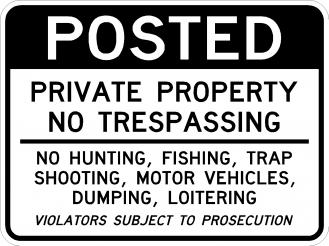 Private Property Signs
Private Property No Trespassing Sign (AR-246)
$21.95 – $72.45
Shop on Trafficsigns.com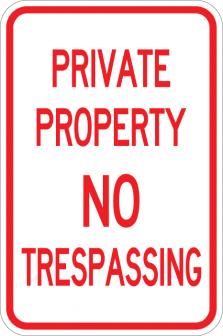 Private Property Signs
Private Property No Trespass Sign (AR-119)
$21.95 – $25.95
Shop on Trafficsigns.com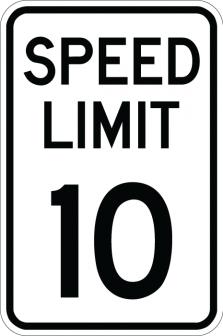 Private Road Speed Limit Signs
Speed Limit 10 Sign (AR-719)
$21.95 – $25.95
Shop on Trafficsigns.com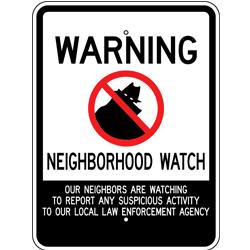
Ready to Sign Your Private Road the Right Way?
Trafficsigns.com carries a full range of private road signs, private property signs, and neighborhood traffic signs made from durable reflective aluminum. All signs meet DOT and MUTCD standards and are available in multiple sizes and reflectivity grades. Whether you need a single entrance sign or a complete signage package for an HOA community, ordering is straightforward and production is fast. Browse the catalog or contact us for bulk pricing on larger orders.
Shop Private Road Signs