
What municipalities, contractors, and property managers need to know about roundabout warning signs and MUTCD placement rules
A roundabout sign alerts drivers to an upcoming circular intersection, giving them time to adjust speed and prepare to yield before entering the circulating roadway. Officially called the Circular Intersection (W2-6) sign in the Manual on Uniform Traffic Control Devices (MUTCD), it's optional at most roundabouts, but the MUTCD says it should be installed on any approach with a speed limit of 40 mph or higher. Trafficsigns.com stocks MUTCD-compliant W2-6 signs in multiple sizes in high intensity and diamond grade sheeting, ready for municipal and contractor orders.
Roundabout Sign Buying Questions
- What material options are available for a roundabout sign?
- Our W2-6 Circular Intersection sign ships on aluminum standard punched blanks in high intensity (very reflective) or diamond grade (ultra reflective) sheeting. Because it's a yellow warning sign, the MUTCD doesn't allow engineer grade. High intensity works well for most local and suburban approaches, while diamond grade is recommended for high-speed approaches where maximum nighttime visibility matters most.
- What size roundabout sign do I need for my intersection?
- Under the MUTCD, the W2-6 sign is 30x30 inches on conventional roads and 36x36 inches on expressways, and diamond-shaped warning signs must be at least 36x36 on multi-lane roads posted above 35 mph. A 24x24 inch sign is the minimum size and is meant for low-speed roads, such as residential streets and mini-roundabouts. A 48x48 inch sign is an oversized option for approaches where drivers need extra emphasis.
- Can I get a custom roundabout traffic sign MUTCD layout for multi-lane circles?
- Yes. Beyond the standard W2-6 sign, we produce companion signs for multi-lane roundabouts, including the Advance Intersection Lane Control Sign (R3-8), which the MUTCD also offers in roundabout versions for directing traffic into the correct lane before entry. The MUTCD also allows an educational plaque reading ROUNDABOUT (W16-12aP) or TRAFFIC CIRCLE (W16-12P) under the W2-6. Contact our team for custom layouts matching your traffic study.
- How much does a roundabout warning sign cost in bulk?
- Pricing depends on size and reflective grade, starting at $73.35 for a 24x24 inch diamond grade sign and scaling up to $256.95 for a 48x48 inch diamond grade sign. Bulk discounts apply automatically: ordering 4 or more drops the price per sign, with the deepest discounts kicking in at 50-plus units, a common order size for counties rolling out roundabout programs across multiple intersections.
- How fast is production and shipping on roundabout signs?
- Standard roundabout signs are stocked items and typically ship within a few business days. Custom sizes or diamond grade orders may add production time. Reach out before placing large municipal orders so we can confirm current lead times for your quantity.
- How do I mount a roundabout ahead sign?
- The W2-6 sign uses standard punched holes compatible with U-channel posts, square tube posts, or existing sign hardware. Mount it on the right side of the roadway in advance of the roundabout entry, following MUTCD placement distances based on posted speed. Pair it with sign blanks and posts if you're building a complete installation from scratch.
- How should I maintain a roundabout sign after installation?
- Reflective sheeting on aluminum holds up well outdoors, but periodic cleaning with mild soap and water keeps the sign reflective and legible. Inspect annually for fading, impact damage, or graffiti, and replace sooner if reflectivity drops below MUTCD minimums, since a dull roundabout sign loses its warning value at night.
What Does a Roundabout Sign Mean?
A roundabout sign, officially labeled W2-6 in the MUTCD and commonly called a circular intersection sign, warns drivers that they are approaching a roundabout where traffic circulates counterclockwise around a central island. The sign displays a circular arrow pattern inside a yellow diamond, visually representing the flow of traffic through the intersection ahead.
The purpose of a roundabout is to keep traffic moving continuously rather than stopping at a four-way intersection. Drivers yield to traffic already in the circle rather than stopping outright, which reduces the severe T-bone and head-on collisions common at signalized intersections. Federal Highway Administration safety research has found fewer injury crashes after intersections are converted to roundabouts, which is one reason more cities are adopting them.
When drivers ask what the circle sign means, they are usually referring to this same W2-6 warning sign. It's sometimes called a "roundabout ahead" sign, and it can be paired with an advisory speed plaque or an educational plaque reading ROUNDABOUT (W16-12aP) or TRAFFIC CIRCLE (W16-12P). Together they alert approaching traffic to slow down and prepare to yield before entering the circulating roadway. For background on how yellow diamond warning signs fit into the broader sign system, see our guide to traffic sign colors and shapes.
Roundabout Sign Types: Standard, Mini, and Multi-Lane Configurations
Not every circular intersection looks the same, but the MUTCD uses the same Circular Intersection (W2-6) warning sign for all of them. A full-size roundabout has a raised central island that vehicles must drive around. A mini-roundabout is a smaller circle, often used in low-speed residential or downtown settings, where larger trucks can drive over a mountable center island. There's no separate "mini roundabout" sign; mini-roundabouts use the same W2-6 sign, usually with a lower advisory speed, since the circle is much tighter.
Beyond the core warning sign, several related signs work together at roundabouts: the W2-6 sign placed before the intersection, an optional advisory speed plaque or ROUNDABOUT educational plaque mounted below it, YIELD signs at each entry, and lane-use signs at multi-lane roundabouts. The MUTCD offers roundabout versions of the advance intersection lane control sign (R3-8) for those lane assignments. Where the central island doesn't provide a good place for a sign, the MUTCD calls for a Roundabout Circulation plaque (R6-5P) under each YIELD sign to show the direction of travel.
Under the MUTCD, the W2-6 is 30x30 inches on conventional roads and 36x36 inches on expressways, and it must be at least 36x36 on multi-lane roads posted above 35 mph. The 24x24 inch minimum size is meant for low-speed roads and mini-roundabouts, and 48x48 inches is an oversized option for approaches where drivers need more time to react. For a broader look at how warning sign sizing is determined across categories, see our guide to common types of traffic signs.
Navigating a Roundabout: Rules and Safety Benefits
Drivers approaching a roundabout sign should slow to the posted advisory speed, scan for pedestrians and cyclists, and yield to any vehicle already circulating in the roadway. Unlike a four-way stop, there is no requirement to come to a complete stop if the roundabout is clear. Traffic simply merges in when a gap appears. Drivers should stay in their lane through the circle, which is especially important at multi-lane roundabouts, signal before exiting, and never stop inside the circulating roadway. Specific driving rules, such as signaling requirements, come from state law, so check your state's driver manual or DOT for the details.
The safety case for roundabouts is well documented. By eliminating the left-turn and straight-through conflict points found at traditional intersections, roundabouts reduce the angles and speeds involved in crashes. A properly placed roundabout warning sign is the first line of defense in that safety improvement, giving drivers the advance notice they need to adjust speed and attention before reaching the circle.
For agencies managing multiple intersection types, our intersection warning signs use-case guide covers how roundabout signage fits into a broader traffic control plan alongside signals and stop-controlled approaches.
Roundabout Sign Size and Material Comparison
Choosing the right roundabout sign comes down to road speed, placement distance, and budget. The table below compares standard W2-6 circular intersection sign options by size and reflective grade.
| Size | Reflective Grade | Base Price | Best Use Case |
|---|---|---|---|
24x24 in | Diamond Grade | $73.35 | Minimum size: low-speed roads and mini-roundabouts |
30x30 in | High Intensity | $87.95 | Standard size on conventional roads |
36x36 in | High Intensity | $174.00 | Expressways, and multi-lane approaches posted above 35 mph |
48x48 in | Diamond Grade | $256.95 | Oversized option for high-speed approaches needing extra emphasis |
Roundabout and Intersection Warning Signs
Stock up on MUTCD-compliant roundabout signs and the companion intersection warning signs used at circular and signalized approaches. As yellow warning signs, they come in high intensity or diamond grade sheeting.
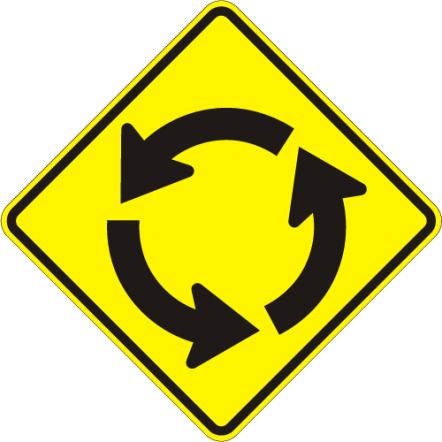 Intersection Warning Signs
Circular Intersection Sign - W2-6
$44.25 - $256.95
Shop on Trafficsigns.com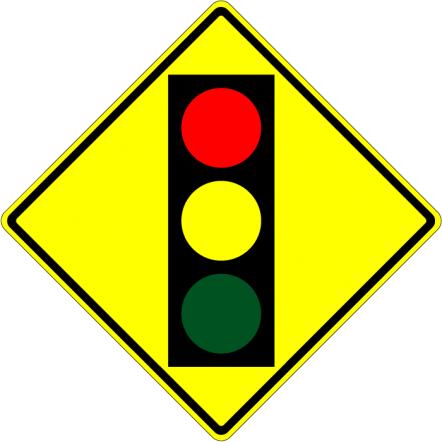 Intersection Warning Signs
Signal Ahead (Symbol) Sign - W3-3
$44.25 - $256.95
Shop on Trafficsigns.com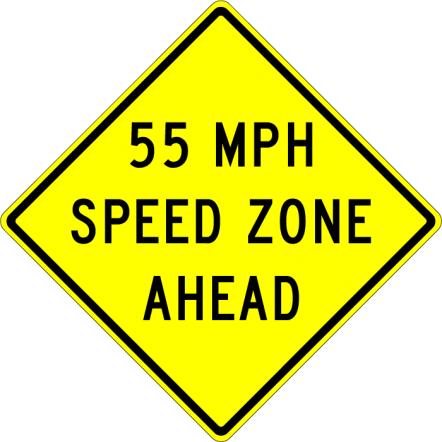
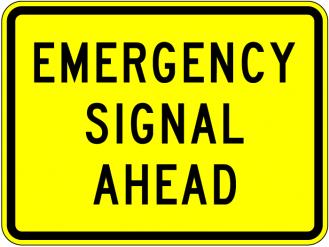 Intersection Warning Signs
Emergency Signal Ahead Sign - W11-12P
$33.25 - $92.50
Shop on Trafficsigns.comOrder MUTCD-Compliant Roundabout Signs Today
Equip your next roundabout project with durable, reflective W2-6 Circular Intersection signs in high intensity or diamond grade sheeting, built to MUTCD standards. Browse our full selection of intersection warning signs or request a quote for bulk municipal orders.