
Everything You Need to Know About MUTCD Stop Sign Standards
The stop sign is one of the most recognized traffic control devices in the world, and its distinctive shape, color, and dimensions are not left to chance. Every stop sign installed on a public road in the United States must conform to strict specifications set by the Manual on Uniform Traffic Control Devices (MUTCD). Whether you are a traffic engineer, facility manager, or property owner, understanding stop sign shape, size, and specifications ensures you stay compliant and keep drivers safe.
Common Questions About Stop Sign Shape and Specifications
- What size stop sign do I need for my parking lot or private property?
- For most private parking lots and internal roads, a 24-inch stop sign is the standard choice. High-traffic commercial driveways and larger intersections typically use a 30-inch sign. The MUTCD recommends 30-inch signs for conventional roads and 36-inch signs for expressways, but local authorities may specify different sizes for private applications. When in doubt, matching the nearest public roadway standard is a safe approach.
- What reflective grade should I order for a stop sign?
- Engineer Grade reflective sheeting is the minimum for most low-speed, low-traffic locations. High Intensity sheeting provides significantly better nighttime visibility and is required on many state and county roads. Diamond Grade offers the highest retroreflectivity available and is specified for high-speed roads and expressways. All three grades sold at Trafficsigns.com meet DOT and MUTCD standards for the appropriate application.
- Do stop signs need to meet MUTCD specifications on private property?
- Private property owners are not always legally required to follow MUTCD standards, but most local codes and liability best practices strongly recommend it. Installing a MUTCD-compliant stop sign with proper retroreflective sheeting, correct octagonal shape, and standardized lettering gives you the best protection in the event of an incident. Many insurance providers and local municipalities expect private signs to match public road standards.
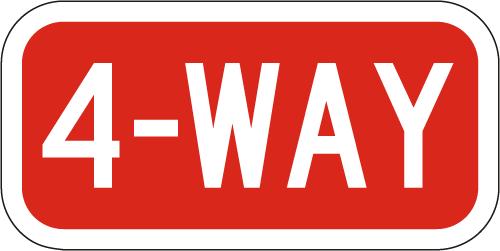
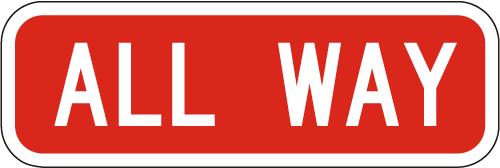
- Can I order a stop sign with a supplemental plate like '4 Way' or 'All Way'?
- Yes. Supplemental plates are mounted directly below the main stop sign and provide additional instruction to drivers. The R1-3 (4 Way) and R1-4 (All Way) are common supplemental sign plates that pair with a standard R1-1 stop sign. These plates are available in matching reflective grades and standard aluminum construction so the complete assembly looks uniform and professional.
- How many mounting holes does a standard stop sign have?
- Standard aluminum stop signs come with pre-punched holes that match industry-standard post hardware. Most 24-inch and 30-inch signs have two holes at the top and two at the bottom, centered for use with standard square or round sign posts. Always confirm hole spacing with your post hardware supplier to ensure compatibility before ordering.
- What is the typical turnaround time for ordering a stop sign?
- Stock stop signs in standard sizes and engineer grade reflective sheeting typically ship within 1 to 3 business days. Custom or higher-grade reflective options may require additional production time. Volume orders may have longer lead times depending on quantity. Contact Trafficsigns.com directly to confirm availability and shipping estimates for your specific order.
- Are bulk pricing discounts available on stop signs and supplemental plates?
- Yes. Trafficsigns.com offers tiered quantity pricing on most regulatory signs including stop signs and supplemental plates. Per-unit pricing decreases at quantity thresholds of 4, 7, 16, and 50 units. For example, a 4 Way Stop supplemental plate (R1-3) in engineer grade starts at $14.95 per unit and drops to $12.56 each at quantities of 50 or more.
Stop Sign Shape: The Octagon Explained
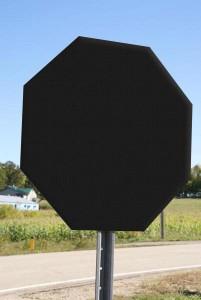
To answer a frequently searched question directly: a stop sign is not a hexagon. A hexagon has six sides, while a stop sign has eight sides, making it an octagon. The confusion sometimes arises because both shapes are polygons, but they are distinctly different. A stop sign is also not a trapezoid. Trapezoids have four sides, two of which are parallel. The stop sign's octagonal form is unique among regulatory signs.
The use of an eight-sided shape for stop signs in the United States became standardized in 1954 when the American Association of State Highway Officials published the first nationally uniform standard. Before that, stop signs varied considerably in shape and color from state to state. The 1954 standardization locked in the octagon as the official stop sign shape across the country, and subsequent editions of the MUTCD have maintained that standard ever since.
MUTCD Stop Sign Specifications: Color, Lettering, and Border
Standard Stop Sign Sizes and Where Each Is Used
Stop Sign Size Comparison by Application
Use this reference to match stop sign dimensions to the right application. All sizes must use retroreflective sheeting that meets current MUTCD minimum requirements.
| Sign Size | Typical Application | Approach Speed | Reflective Grade Recommended |
|---|---|---|---|
| 24 inch | Parking lots, private roads, low-speed driveways | Under 25 mph | Engineer Grade minimum |
| 30 inch | Local streets, residential intersections, city roads | 25 to 40 mph | High Intensity or Engineer Grade |
| 36 inch | Arterial roads, state routes, rural intersections | 40 to 55 mph | High Intensity or Diamond Grade |
| 48 inch | Expressways, divided highways, overhead mounting | 55 mph and above | Diamond Grade |
Stop Signs and Supplemental Plates Available at Trafficsigns.com

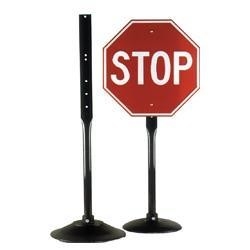
Order MUTCD-Compliant Stop Signs and Accessories
Trafficsigns.com carries a full range of stop sign supplemental plates, sign covers, and mounting hardware. All reflective signs are manufactured to DOT and MUTCD standards with volume pricing available for larger orders. Browse the regulatory signs category to find the right product for your application, or contact the team for help selecting the correct size and reflective grade.
Shop Stop Signs and Regulatory Signs