
Understand the regulatory standards, placement criteria, and practical differences that determine the right right-of-way sign for any intersection.
Choosing between a stop sign and a yield sign is not a matter of preference. The Manual on Uniform Traffic Control Devices (MUTCD) provides specific warrants and conditions that determine which sign is appropriate for a given location. Installing the wrong control device can create liability, increase crash risk, and put your installation out of compliance with federal and state standards. This guide breaks down the stop sign vs. yield sign decision in clear, practical terms so engineers, traffic managers, property owners, and municipalities can make the right call.
Common Questions About Stop Signs vs. Yield Signs
- Is a yield sign the same as a stop sign?
- No. A yield sign requires drivers to slow down and give the right of way to conflicting traffic, but they do not need to come to a complete stop if the roadway is clear. A stop sign requires a complete stop every time, regardless of whether other vehicles are present. The two signs impose different legal obligations on the driver and are selected based on different traffic engineering criteria.
- Can you legally stop at a yield sign?
- Yes. Stopping at a yield sign is legal and required if traffic conditions make it necessary to yield safely. Drivers must yield the right of way, and if that requires a full stop, they must stop. The difference from a stop sign is that stopping is not mandatory when the path is clear.
- Does a yield sign or a stop sign go first at a shared intersection?
- When both signs are present at the same intersection, the stop sign takes precedence because it imposes a stricter obligation. Yield signs are generally placed on lower-priority approaches where gaps in traffic are frequent enough that a full stop is not always warranted. If conditions require a stop sign on a given approach, a yield sign is not a substitute.
- What size stop sign or yield sign do I need for my application?
- The MUTCD specifies minimum sizes based on road classification. For stop signs (R1-1), the standard size on conventional roads is 30 inches; 36 inches is used on expressways and high-speed roads. For yield signs (R1-2), the standard is 36 inches on conventional roads and 48 inches on higher-speed facilities. Always confirm your local jurisdiction's requirements, as some states enforce larger minimums.
- What reflective material grade should I order for a stop or yield sign?
- Engineer Grade (Type I) reflective sheeting meets minimum MUTCD standards for many lower-speed applications. High Intensity (Type III) sheeting provides significantly greater retroreflectivity and is recommended for higher-speed roads and locations with poor ambient lighting. Diamond Grade (Type XI) delivers the highest retroreflectivity and is appropriate for expressways, high-speed rural roads, and any location requiring maximum nighttime visibility. Check your agency's retroreflectivity management plan to confirm which grade is required.
- Are bulk pricing discounts available when ordering multiple stop or yield signs?
- Yes. Trafficsigns.com offers tiered volume pricing on regulatory signs. As order quantity increases, the per-unit price decreases. For example, on many standard regulatory signs, pricing breaks occur at 4, 7, 16, and 50 units. Ordering in volume is common for municipalities, contractors, and property managers replacing multiple signs across a site.
- Can I install a stop sign on private property without following MUTCD standards?
- MUTCD standards are federally required on public roads. On private property such as parking lots, shopping centers, and campuses, MUTCD compliance is generally not legally mandated, but following its guidance is strongly recommended. Signs that match public road standards reduce driver confusion and support any liability defense should an incident occur. Reflective aluminum signs meeting MUTCD specs are available in standard sizes suitable for private property use.
What the MUTCD Says About Stop Sign vs. Yield Sign Selection
A stop sign (R1-1) is warranted when: (1) an intersection is not controlled by traffic signals and operates on a multi-way stop basis, (2) a combination of approach speed, sight distance limitations, crash history, or traffic volumes indicates that drivers cannot reliably assess gaps in traffic without stopping, or (3) a road intersects with a highway or arterial where a full stop is needed to safely enter the traffic stream.
A yield sign (R1-2) is appropriate when: (1) a vehicle on a minor road can safely yield to traffic on a major road without always stopping, (2) the intersection involves merging traffic or a channelized turn where gaps are predictable, (3) crash experience or traffic studies show that a stop sign would produce unwarranted delay, or (4) a pedestrian crosswalk requires drivers to yield without halting all movement.
The MUTCD explicitly discourages using stop signs to control speed or as a substitute for a traffic signal. Installing a stop sign where a yield sign is appropriate typically increases driver frustration and can lead to rolling stop behavior, which reduces rather than improves safety. Conversely, placing a yield sign where a stop sign is warranted can create inadequate gap assessment and increase conflict.
For intersections with complex lane assignments, devices like the Advance Intersection Lane Control Sign or the Intersection Lane Control Sign R3-30ACA may supplement a stop or yield sign to clarify turning movements.
Key Physical Differences Between Stop Signs and Yield Signs
The stop sign (R1-1) is an octagon, a shape used exclusively for stop control across North America. Its background is red with a white border, white legend, and white letters spelling STOP. The eight-sided shape is instantly recognizable even when the sign face is obscured by snow or debris. To directly answer a common question: yes, the standard stop sign has 8 sides, not 6. A hexagon is a six-sided shape and is used for school zone signs, not stop signs.
The yield sign (R1-2) is an equilateral triangle with the point facing downward. Its background is red with a white border and white legend reading YIELD. Prior to 1971, yield signs in the United States used a yellow background; the current red background was adopted to create a stronger association with the red-stop convention and to improve nighttime recognition. Drivers occasionally ask about yellow yield signs, and while older examples still exist in the field, any new installation should use the current red design per MUTCD specifications.
Both signs are manufactured on reflective aluminum blanks with radius corners and pre-punched mounting holes. The reflective sheeting grade determines nighttime brightness, and the MUTCD sets minimum retroreflectivity requirements that agencies are required to maintain through a retroreflectivity management program.
For intersections where a stop condition applies to pedestrians rather than vehicles, signs like the Stop Here for Pedestrians Right Sign (R1-5BR) or the Stop for Pedestrians Right Sign (R1-5CR) provide the correct in-street crosswalk control device.
Stop Sign Placement and Installation Requirements
On multi-lane approaches or where sight distance is limited, a supplemental stop sign may be mounted overhead or on the left side of the road. The 4-Way Stop Sign (R1-3) is used below the main stop sign to inform drivers that all approaches are controlled, which is particularly important when drivers are unfamiliar with the intersection.
For temporary traffic control in construction zones, supplemental advance warning such as a Be Prepared to Stop sign (W3-4) provides drivers with early notice that a stop condition lies ahead. This is especially critical when the stop is positioned around a curve or beyond a crest where stopping sight distance is reduced.
Sign size requirements: 30 inches is standard for most conventional roads and streets. 36 inches is required for expressways, freeways, and roads with higher posted speeds. Some jurisdictions require 36-inch signs on any road with a speed limit above 45 mph.
Reflective material selection for stop signs: Engineer Grade is acceptable at lower speeds in well-lit areas. High Intensity or Diamond Grade is required or strongly recommended for higher-speed roads and rural locations where ambient light is limited. All grades available from Trafficsigns.com meet DOT and MUTCD standards.
Yield Sign Placement and Installation Requirements
2. Roundabout entries, where each approach must yield to circulating traffic.
3. Channelized right-turn lanes that merge with a major road.
4. Shared-use paths and multi-use trail crossings at low-volume roadways.
5. Intersections where a stop sign would generate excessive delay relative to the actual crash risk.
Stop Sign vs. Yield Sign: Side-by-Side Comparison
The table below summarizes the primary regulatory, physical, and placement differences between stop signs and yield signs as defined by the MUTCD and standard traffic engineering practice.
| Attribute | Stop Sign (R1-1) | Yield Sign (R1-2) |
|---|---|---|
| MUTCD Designation | R1-1 | R1-2 |
| Shape | Octagon (8 sides) | Downward-pointing triangle |
| Background Color | Red | Red |
| Legend Color | White | White |
| Legend Text | STOP | YIELD |
| Driver Obligation | Complete stop required every time | Slow down; stop only if traffic requires it |
| Standard Size (Conventional Road) | 30 inches | 36 inches per side |
| Standard Size (High-Speed / Expressway) | 36 inches | 48 inches per side |
| Typical Use Case | Multi-way stops, limited sight distance, high-conflict intersections | Minor road meets major road with adequate gaps, roundabout entries, merge areas |
| Advance Warning Sign | Stop Ahead (W3-1) | Yield Ahead (W3-2) |
| Minimum Mounting Height (Urban) | 5 feet to bottom of sign | 5 feet to bottom of sign |
| Reflective Material Options | Engineer Grade, High Intensity, Diamond Grade | Engineer Grade, High Intensity, Diamond Grade |
| MUTCD Warrant Basis | Traffic volume, sight distance, crash history, multi-way stop criteria | Gap availability, traffic volume, merge conditions, crash history |
| Can Be Used at Same Intersection? | Yes, on different approaches | Yes, on different approaches |
Related Traffic Control Signs for Intersections


 Regulatory Signs / Stop & Yield Signs
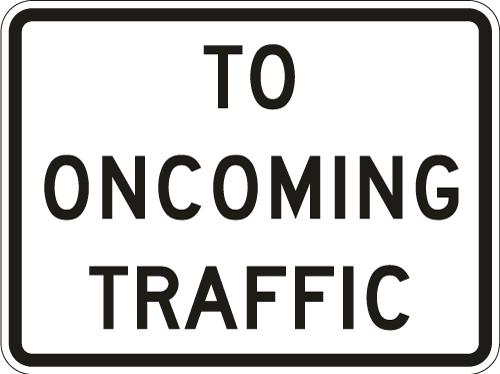
To Oncoming Traffic (Plaque) Sign - R1-2a
From $33.25
Shop on Trafficsigns.com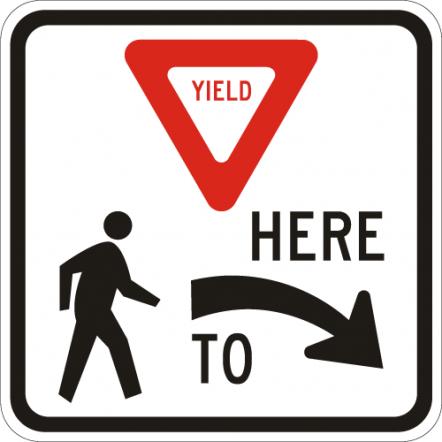 Regulatory Signs / Stop & Yield Signs
Yield to Pedestrians Here Right Sign - R1-5R
From $34.15
Shop on Trafficsigns.com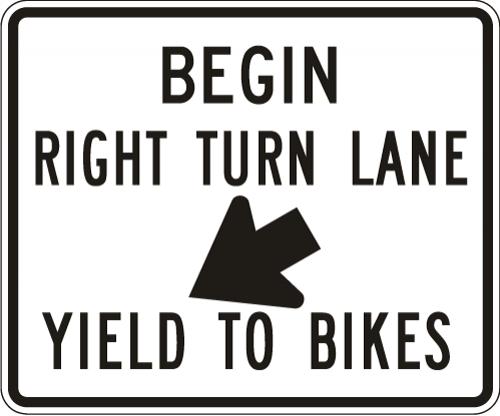 Regulatory Signs / Traffic Control Signs
Right Turn Lane Yield to Bikes - R4-4
From $33.25
Shop on Trafficsigns.comOrder MUTCD-Compliant Stop and Yield Signs
Trafficsigns.com carries a full range of regulatory and warning signs for intersection traffic control, including stop signs, yield signs, supplemental plaques, and advance warning signs. All products are manufactured on reflective aluminum and available in Engineer Grade, High Intensity, and Diamond Grade sheeting to meet your retroreflectivity requirements. Volume pricing is available for municipality, contractor, and large-scale property management orders.
Shop Regulatory Signs