
Understand Retroreflectivity Standards and Choose the Right Reflective Grade for Your Signs
Common Questions About Traffic Sign Reflectivity Requirements
- What is retroreflectivity?
- Retroreflectivity is the optical property that causes light to reflect back toward its source rather than scattering in other directions. On a traffic sign, tiny glass beads or microprismatic elements embedded in the sheeting return a vehicle's headlight beam directly to the driver's eyes. The result is a bright, readable sign in darkness even when the headlights are the only illumination. The higher the retroreflectivity coefficient (measured in mcd/lux/m²), the more visible the sign at night and in adverse weather.
- Why are traffic signs reflective?
- Traffic signs must be visible at night and in low-light conditions such as dusk, dawn, rain, and fog. A non-reflective sign relies entirely on external streetlighting, which is absent on most rural and suburban roads. Reflective sheeting returns a driver's own headlight beam back to their eyes, giving them enough reaction time to read the sign and respond safely. The FHWA mandates retroreflective sign requirements because nighttime crash rates drop significantly when signs meet or exceed minimum retroreflectivity levels.
- What does the MUTCD require for traffic sign retroreflectivity?
- The MUTCD (Section 2A.08 and associated tables) establishes minimum retroreflectivity levels for each sign color combination and roadway speed. For example, white-on-green overhead guide signs on high-speed highways must meet higher coefficient values than the same colors on low-speed local roads. The FHWA's 2007 Final Rule requires agencies to have a sign management assessment that ensures signs are replaced before they fall below minimum retroreflectivity levels. Sign sheeting must also meet ASTM D4956 Type classifications that correspond to those MUTCD thresholds.
- What reflective sheeting grades are available, and which do I need?
- The three grades sold at Trafficsigns.com map directly to ASTM D4956 types. Engineer Grade (Type I) is the entry-level option suitable for low-speed roads, parking areas, and off-road applications. High Intensity (Type III/IV) meets MUTCD standards for most regulatory and warning signs on public roads up to highway speeds. Diamond Grade (Type IX/XI) provides ultra-high retroreflectivity for high-speed highways, school zones, and locations with overhead mounting or long sighting distances. For most municipal and commercial applications, High Intensity or Diamond Grade is the appropriate choice under current MUTCD reflectivity standards.
- How often should reflective signs be replaced?
- Replacement intervals depend on the sheeting grade and the sign's exposure conditions. Engineer Grade sheeting typically maintains minimum retroreflectivity levels for 7 years. High Intensity sheeting carries a manufacturer warranty of approximately 10 years. Diamond Grade sheeting is warranted for 12 years or more. However, actual degradation varies with UV exposure, vandalism, and cleaning frequency. The MUTCD requires agencies to track sign age and condition and replace any sign that falls below the minimum retroreflectivity level for its color and category, regardless of age.
- Are retroreflective sign requirements different for warning signs versus regulatory signs?
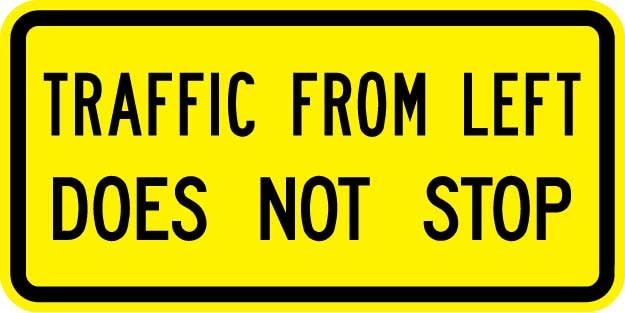
- Yes. The MUTCD specifies minimum retroreflectivity levels by sign color combination, not just by sign type. Yellow-on-black warning signs (such as the W4-4A Traffic From Left Does Not Stop Sign) must meet the threshold for that color pair, while white-on-red regulatory signs (stop signs) must meet a higher threshold because drivers depend on them for critical right-of-way decisions. School zone signs, overhead signs, and freeway guide signs all have distinct minimum levels based on their color combinations and roadway classification.
- Do private property signs need to meet MUTCD retroreflectivity standards?
- MUTCD standards are federally required for signs on public roads. Private property signs, such as parking lot signs or signs on private industrial roads, are not legally required to comply with MUTCD retroreflectivity levels. That said, choosing High Intensity or Diamond Grade sheeting for private applications still improves nighttime visibility, reduces liability exposure, and extends the sign's service life. Many property managers voluntarily specify MUTCD-compliant reflective sheeting for exactly those reasons.
Understanding MUTCD Reflectivity Standards
- High Intensity (Type III/IV): Meets MUTCD minimums for regulatory and warning signs on the majority of public roads including arterials and collectors.
- Diamond Grade (Type IX/XI): Typically exceeds MUTCD minimums for all sign categories and is specified for high-speed highways, school zones, overhead guide signs, and locations requiring maximum nighttime conspicuity.
Minimum Retroreflectivity Levels by Sign Color
- Black on Yellow (Warning signs such as school zone and intersection warning): 50 mcd/lux/m² minimum.
- Black on Orange (Construction zone signs): 50 mcd/lux/m² minimum.
- White on Green (Guide signs, street name signs): 7 to 15 mcd/lux/m² minimum, depending on how large the sign is.
- White on Brown (Recreation/cultural interest signs): 7 mcd/lux/m² minimum.
How to Choose the Right Reflective Grade for Your Application
Reflective Sheeting Grades Compared: Engineer Grade vs. High Intensity vs. Diamond Grade
The three sheeting grades stocked at Trafficsigns.com cover the full range of MUTCD retroreflectivity standards. Use this comparison to identify the right specification for your signs.
| Feature | Engineer Grade (Type I) | High Intensity (Type III/IV) | Diamond Grade (Type IX/XI) |
|---|---|---|---|
| ASTM D4956 Type | Type I | Type III / Type IV | Type IX / Type XI |
| Retroreflectivity Level | Standard | Very High | Ultra High |
| Typical Service Life | 7 years | 10 years | 12+ years |
| MUTCD Compliance (Public Roads) | Low-speed local roads only | Regulatory and warning signs on most public roads | All sign categories, all road classifications |
| Best For | Private property, parking lots, low-speed supplemental signs | Arterials, collectors, regulatory and warning signs | Highways, school zones, overhead signs, high-speed roads |
| Nighttime Visibility | Good | Very Good | Excellent |
| Angle Performance | Narrow observation angle | Wider angle range | Widest observation and entrance angle range |
| Relative Cost | Lowest | Moderate | Highest upfront, lowest lifecycle cost |
MUTCD-Compliant Reflective Traffic Signs
Every sign below is manufactured on reflective aluminum and available in Engineer Grade, High Intensity, or Diamond Grade sheeting to match your traffic sign reflectivity requirements. Pricing starts at the base Engineer Grade unit price; upgrade to High Intensity or Diamond Grade at checkout.
Order MUTCD-Compliant Reflective Traffic Signs Today
Trafficsigns.com stocks hundreds of regulatory, warning, and guide signs manufactured on reflective aluminum to meet current traffic sign reflectivity requirements. Every sign ships ready to mount, with your choice of Engineer Grade, High Intensity, or Diamond Grade sheeting. Need a custom sign? Our custom reflective aluminum signs are built to the same MUTCD standards as our stock catalog. Browse the full selection or contact our team for volume pricing on larger orders.
Shop Reflective Traffic Signs