
Guide drivers safely through sharp bends with W1-8 chevron signs built to MUTCD standards
A chevron alignment sign is one of the most effective tools a road agency, contractor, or property manager has for reducing run-off-road crashes on sharp curves. Officially designated W1-8 in the MUTCD, this black-and-yellow vertical rectangle with a chevron symbol is placed in a series around the outside of a curve, tracing its path so drivers can judge how sharply the road turns before they're committed to it. Trafficsigns.com stocks the full chevron and horizontal alignment sign family in high intensity and diamond grade reflective aluminum, so you can match the sign to the speed and visibility demands of your roadway.
Chevron Alignment Sign Questions Buyers Ask
- What does a chevron alignment sign mean when I see it on the road?
- A chevron alignment sign tells drivers they're in a sharp curve, and the chevron points in the direction they need to steer. Unlike a curve warning sign that simply announces a bend is coming, chevrons are mounted in a series around the outside of the curve itself, giving drivers a continuous visual reference. Under the MUTCD, chevrons are used, along with an advance curve warning sign, where the safe speed through the curve is 20 mph or more below the road's speed, on roads that need curve warning devices based on road type and traffic volume. You'll typically see them on rural highways, mountain roads, and ramps.
- Should chevron signs point up or down, or left and right instead?
- Chevron alignment signs don't point up or down like a rank insignia (a common source of confusion). The W1-8 arrow points left or right to match the direction of the curve, which is why the sign comes in mirror-image versions: W1-8L for left-curving roads and W1-8R for right-curving roads. Choosing the correct orientation matters, since an incorrectly mounted chevron can actually mislead drivers instead of guiding them.
- What sizes and reflective grades are available for the chevron alignment sign?
- Under the MUTCD, the W1-8 chevron sign is 18 x 24 inches on conventional roads, 30 x 36 on expressways, and 36 x 48 on freeways, with 24 x 30 as an oversized option for conventional roads. The companion W1-10 horizontal alignment/intersection signs come in 24 x 24, 30 x 30, and 36 x 36 inch sizes. Because these are yellow warning signs, they come in high intensity or diamond grade sheeting; the MUTCD doesn't allow engineer grade on yellow signs. As standardized MUTCD symbols, they need no custom artwork. You simply select the size, direction (left or right), and reflective grade.
- How is pricing structured for chevron alignment signs, and are there bulk discounts?
- Pricing varies by size and reflective grade, with high intensity and diamond grade options for these yellow warning signs. Volume pricing kicks in at 4, 7, 16, and 50 units, which is worth planning for if you're outfitting an entire curve series or a stretch of county road.
- How far apart should chevron signs be spaced along a curve?
- The MUTCD gives typical spacing based on the curve's advisory speed and radius, measured from the start of the curve: about 40 feet apart for curves with an advisory speed of 15 mph or less, 80 feet at 20 to 30 mph, 120 feet at 35 to 45 mph, 160 feet at 50 to 60 mph, and 200 feet above 60 mph. Chevrons should also be visible far enough ahead to give drivers time to react. A field review of the specific curve is the best way to confirm exact spacing before ordering quantities.
- How long does it take to receive chevron signs, and how are they installed?
- Standard chevron and horizontal alignment signs typically ship within a few business days since they're stocked in common MUTCD sizes and grades. Installation is straightforward: signs come on aluminum blanks with pre-punched holes, so they mount directly to U-channel posts or existing sign posts with standard hardware. The MUTCD requires chevrons to be mounted on the outside of the curve, at roughly a right angle to approaching traffic, with the bottom of the sign at least 4 feet above the edge of the travel lane.
- How should I maintain a chevron sign once it's mounted?
- Rinse the reflective aluminum surface periodically with water and a mild detergent to remove road film, dirt, and salt buildup, which can dull reflectivity over time. Avoid abrasive brushes that can scratch the reflective sheeting. Diamond grade sheeting holds its retroreflective performance longest, so if the sign sits on a high-speed or high-crash curve, it's worth the upgrade to extend the usable life of the sign before replacement is needed.
What Does a Chevron Alignment Sign Mean?
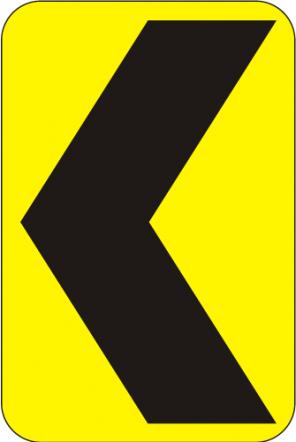
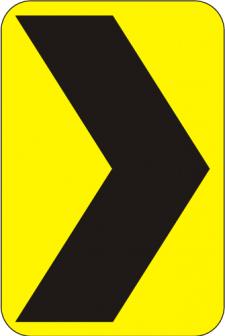
The chevron alignment sign, designated W1-8 in the MUTCD chevron sign catalog, is a yellow vertical rectangle with a black chevron symbol, and no border, that points in the direction traffic must follow through a sharp curve. It differs from a standard curve warning sign in one key way: instead of being placed before the curve to announce that a bend is coming, chevrons are installed in a series along the outside of the curve itself, tracing the actual path of the road as it bends. Drivers scanning ahead can follow the line of arrows with their eyes and judge how sharply the road turns well before they're committed to the turn.
The MUTCD ties chevrons to how much drivers must slow down for the curve. On roads that need curve warning devices, based on road type and traffic volume, a curve whose advisory speed is 5 to 10 mph below the road's speed gets an advance curve warning sign. At 15 mph, delineators are added, and at 20 mph or more, chevrons are added along with the advance warning sign. That's why you'll see them most often on rural highways with tight bends, mountain switchbacks, and interchange ramps. For gentler curves, a curve warning sign on the approach is often enough on its own.
Chevron Signs vs. Curve Warning Signs and Horizontal Alignment Signs
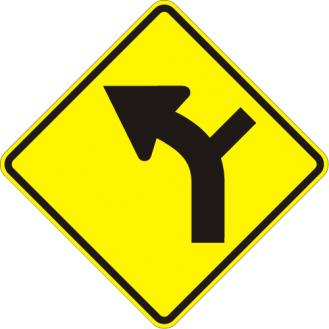
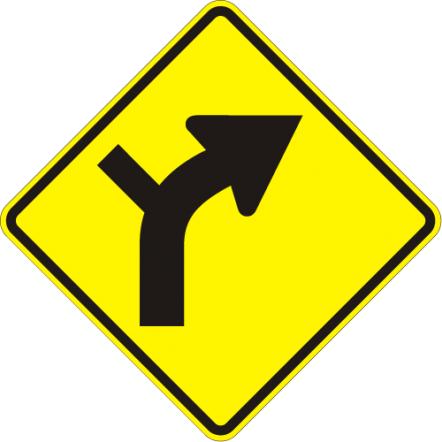
It helps to understand where the chevron road sign fits alongside the rest of the curve warning family. A curve left warning sign or curve right warning sign (W1-2) is an advance warning sign posted before the curve begins, alerting drivers that a turn is coming and in which direction. Horizontal alignment signs in the W1-10 series go a step further by combining the curve warning with additional context, such as a side road or cross road intersecting the curve, so drivers understand both the turn and the intersection risk at once.
The chevron alignment sign is different from both. Rather than warning drivers before the curve, it's mounted through the curve to trace the path visually in real time. You may hear people talk about "double" or "triple" chevrons, but those aren't MUTCD terms; the MUTCD simply calls for chevrons spaced evenly around the curve based on its advisory speed. These are distinct from a winding road sign (multiple curves in quick succession) or a reverse curve sign (a curve followed immediately by one in the opposite direction), both of which serve as advance warnings rather than in-curve guidance. You can browse the full lineup, including left and right curve, cross road, and side road variants, in the curve and turn signs category.
Chevron Sign Placement and Spacing Requirements
Placement matters as much as the sign itself. The MUTCD requires chevron alignment signs to be mounted on the outside of the curve, at roughly a right angle to approaching traffic, with the bottom of the sign at least 4 feet above the edge of the travel lane. Chevrons may be used instead of, or along with, standard delineators, and yellow LEDs outlining the chevron symbol are allowed for extra visibility.
Spacing is based on the curve's advisory speed and radius, measured from the point where the curve begins. The MUTCD's typical spacing is:
- 15 mph or less (radius under 200 feet): 40 feet
- 20 to 30 mph (200 to 400 feet): 80 feet
- 35 to 45 mph (401 to 700 feet): 120 feet
- 50 to 60 mph (701 to 1,250 feet): 160 feet
- More than 60 mph (over 1,250 feet): 200 feet
- 20 to 30 mph (200 to 400 feet): 80 feet
- 35 to 45 mph (401 to 700 feet): 120 feet
- 50 to 60 mph (701 to 1,250 feet): 160 feet
- More than 60 mph (over 1,250 feet): 200 feet
The MUTCD also lists a few places chevrons shall not go: on the far side of a T-intersection (that's the job of a Large Arrow sign), on obstructions or the start of a guardrail (that's the job of an object marker), or pointing right in the central island of a roundabout or neighborhood traffic circle.
Material choice affects how well that spacing performs after dark. High intensity sheeting is a common choice for local roads and state highways, and diamond grade delivers the strongest retroreflectivity for curves with higher posted speeds or a history of nighttime crashes. Because chevrons are yellow, the MUTCD doesn't allow engineer grade sheeting on them.
Chevron and Curve Alignment Sign Comparison
Compare the most common W1-8 and W1-10 sign options to find the right fit for your curve, intersection, or road segment.
| Sign | MUTCD Code | Primary Use | Available Sizes | Pricing |
|---|---|---|---|---|
Chevron Left / Right Sign | W1-8L / W1-8R | Traces the path around a sharp curve, used where the advisory speed is 20 mph or more below the road's speed | 18" x 24" (conventional), 30" x 36" (expressway), 36" x 48" (freeway); 24" x 30" oversized | Varies by size and grade (high intensity or diamond) |
Horizontal Alignment/Intersection Sign | W1-10L / W1-10R | Marks a directional change combined with an upcoming intersection | 24" x 24", 30" x 30", 36" x 36" | Varies by size and grade (high intensity or diamond) |
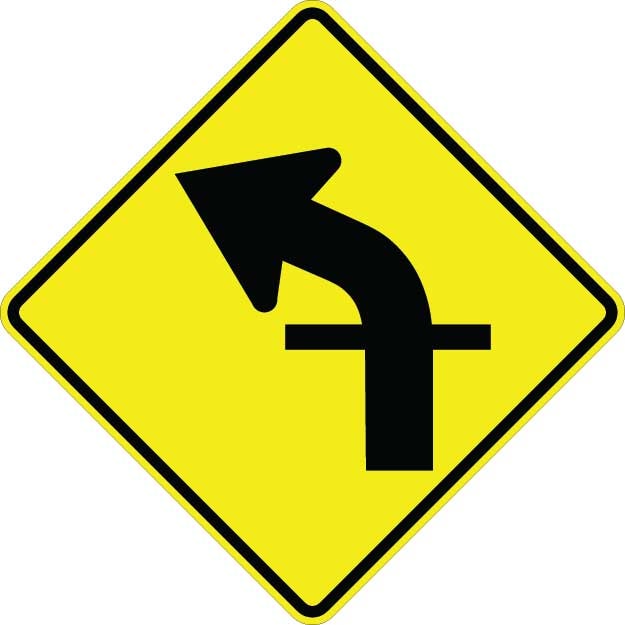
Curve Left With Cross Road Sign | W1-10AL / W1-10EL | Warns of a curve combined with a crossing road ahead | 24" x 24" up to 48" x 48" | Varies by size and grade (high intensity or diamond) |
Curve Left With Side Road Sign | W1-10BL / W1-10DL | Warns of a curve combined with a side road entering the curve | 24" x 24" up to 48" x 48" | Varies by size and grade (high intensity or diamond) |
Shop Chevron and Horizontal Alignment Signs
Reflective aluminum chevron and horizontal alignment/intersection signs, built to MUTCD standards in high intensity and diamond grade sheeting.
 Curve & Turn Signs
Curve Left With Cross Road Sign - W1-10AL
$44.25 - $256.95
Shop on Trafficsigns.comOrder MUTCD-Compliant Chevron and Curve Signs Today
Whether you're signing a single sharp curve or outfitting an entire stretch of rural highway, Trafficsigns.com stocks the full chevron alignment sign and horizontal alignment sign lineup in reflective high intensity and diamond grade aluminum. Browse sizes, compare grades, and take advantage of volume pricing on bulk orders.