
Understanding HAWK signals, PHB sequencing, and the crosswalk signs that support safe pedestrian crossings
A pedestrian hybrid beacon, often called a HAWK signal or HAWK beacon, is a specialized traffic control device designed to stop vehicle traffic only when a pedestrian needs to cross. Unlike a standard traffic signal, it stays dark until activated, then cycles through a specific sequence of lights to safely bring vehicles to a stop. Pedestrian hybrid beacons work alongside regulatory and warning signage, crosswalk markings, and pedestrian traffic signals to create a complete crossing system. This guide explains how a pedestrian hybrid beacon operates, how it compares to other crosswalk traffic control options, and which pedestrian crossing signs agencies and property owners typically pair with a PHB installation.
Common Questions About Pedestrian Hybrid Beacons
- How does a pedestrian hybrid beacon work?
- A pedestrian hybrid beacon stays completely dark until a pedestrian presses the call button. Once activated, it moves through a set sequence: a flashing yellow warning phase, a brief solid yellow phase, a solid dual red phase during which vehicles must come to a complete stop, and an alternating flashing red (wig-wag) phase that allows drivers to proceed once the crosswalk is clear. When the cycle ends, the beacon returns to dark until the next pedestrian activates it.
- What is the difference between a HAWK signal and a pedestrian hybrid beacon (PHB)?
- There is no functional difference. HAWK signal and HAWK beacon are the original names used when the device was piloted in Tucson, Arizona (High-intensity Activated crossWalK). When the Federal Highway Administration formally adopted the device into the MUTCD, it was renamed the pedestrian hybrid beacon. Both terms describe the exact same signal sequence and hardware.
- How much does a pedestrian hybrid beacon cost to install?
- A full pedestrian hybrid beacon installation, including poles, signal heads, foundations, wiring, controller cabinet, and pavement markings, is often estimated at roughly $50,000 to $150,000 or more (costs aren't set by the MUTCD and vary widely by location) depending on the crossing width, utility work, and local labor rates. That figure is separate from the supporting signage, such as pedestrian crosswalk signs and pedestrian traffic signal signs, which is a much smaller line item by comparison.
- What does a flashing red light on a pedestrian hybrid beacon mean?
- Alternating flashing red lights on a pedestrian hybrid beacon (sometimes called the wig-wag phase) mean drivers should treat the signal like a stop sign. Vehicles must come to a complete stop, then may proceed through the crossing once they confirm no pedestrians remain in the crosswalk and the way is clear.
- What does it mean when a pedestrian hybrid beacon is dark, with all lights off?
- A pedestrian hybrid beacon with all lights darkened is in its default resting state. No pedestrian has activated the crossing, so drivers may proceed through the intersection as usual, following any posted crosswalk or pedestrian crossing signs at the location, such as a Cross Only At Crosswalks Sign or nearby pedestrian crossing warning sign. Drivers still need to yield to pedestrians in the crosswalk under state law, even when the beacon is dark, so check with your state DOT or local agency for the rules in your area. The beacon only lights up once a pedestrian requests a crossing.
- How does a pedestrian hybrid beacon differ from a rectangular rapid flashing beacon (RRFB)?
- A pedestrian hybrid beacon includes a solid red phase that legally requires drivers to stop, similar to a traffic signal. A rectangular rapid flashing beacon (RRFB) never displays red. It flashes rapid amber lights to draw driver attention to a crosswalk but does not carry the same legal stop requirement. The 11th edition of the MUTCD covers RRFBs in Chapter 4L, where they may only supplement a Pedestrian (W11-2), School (S1-1), or Trail (W11-15) crossing warning sign at a marked crosswalk without stop or yield control. Agencies generally choose a PHB for higher-speed or higher-volume roads and reserve RRFBs for lower-volume crossings where a full signal isn't warranted.
- What crosswalk and pedestrian signs should be installed with a pedestrian hybrid beacon, and what material holds up best outdoors?
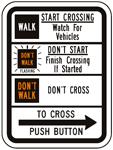
- The MUTCD requires a pedestrian hybrid beacon to be used with signs and pavement markings. Common options include a CROSSWALK STOP ON RED (R10-23) or STOP ON STEADY RED, YIELD ON FLASHING RED AFTER STOP (R10-23a) sign facing drivers on each approach, and advance Pedestrian (W11-2) or School (S1-1) warning signs. At the push button, a Pedestrian Traffic Signal Sign (R10-3c) tells pedestrians how to request the crossing. The Pedestrian Crosswalk Sign (R9-8) is a different case: the MUTCD uses it to mark temporary crosswalks in work zones. For outdoor durability, engineer grade reflective aluminum works for white regulatory signs at lower-traffic sites, while yellow or fluorescent yellow-green warning signs like the W11-2 need high intensity or diamond grade sheeting under the MUTCD. High intensity and diamond grade also reflect headlights more effectively and hold their reflectivity longer.
How a Pedestrian Hybrid Beacon Sequence Works
Pedestrian Hybrid Beacons and the Signage That Supports Them
- Pedestrian signal heads (WALK and DON'T WALK) at each end of the crosswalk.
- A stop line on each approach.
- At least two beacon faces for each approach on the main street.
- STOP signs on any side-street approaches if the beacon is at or next to an intersection.
- The MUTCD also recommends no parking or other sight obstructions for at least 100 feet before and 20 feet beyond the crosswalk.
Choosing Between a Pedestrian Hybrid Beacon, RRFB, and Standard Crosswalk Signage
Pedestrian Hybrid Beacon vs. Other Crosswalk Traffic Control Devices
| Device | MUTCD Classification | Signal Sequence | Typical Use Case | Approximate Cost Range |
|---|---|---|---|---|
Pedestrian Hybrid Beacon (HAWK) | MUTCD Chapter 4J | Dark, flashing yellow, solid yellow, solid dual red, alternating flashing red | Mid-block crossings and locations that don't meet a full signal warrant | Roughly $50,000 to $150,000+ installed (estimate) |
Rectangular Rapid Flashing Beacon (RRFB) | MUTCD Chapter 4L | Pedestrian-activated rapid amber flash, no red phase | Lower-volume crossings that need extra driver attention | Roughly $15,000 to $30,000 installed (estimate) |
Standard Pedestrian Signal | MUTCD Chapter 4I | Walk, flashing don't walk, solid don't walk | Signalized intersections already controlling vehicle traffic | Included in full signal cost, often $150,000+ (estimate) |
Static Crosswalk Signage Only | MUTCD Chapters 2B (regulatory) and 2C (warning) | No active signal, static warning and regulatory signs only | Low-traffic residential or campus crossings | $20 to $125 per sign |
Pedestrian Crossing Signs for Beacon and Crosswalk Installations
 Regulatory Signs / Pedestrian Signs
Pedestrian Traffic Signal Sign - R10-3c
Push-button sign, mounted at the pedestrian push button
$16.95 - $22.95
Shop on Trafficsigns.com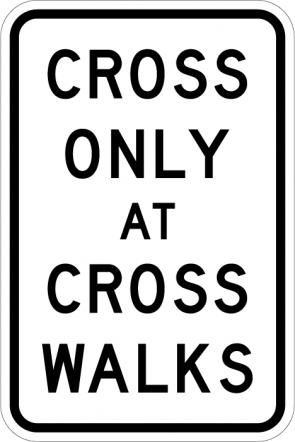 Regulatory Signs / Pedestrian Signs
Cross Only At Crosswalks Sign - R9-2
$21.95 - $92.50
Shop on Trafficsigns.com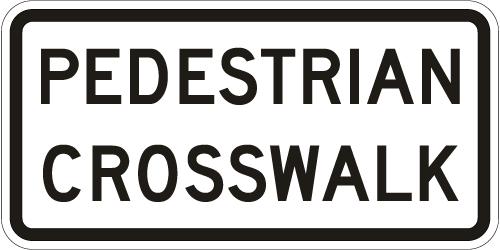 Regulatory Signs / Pedestrian Signs
Pedestrian Crosswalk Sign - R9-8
For temporary crosswalks in work zones
$49.75 - $123.75
Shop on Trafficsigns.com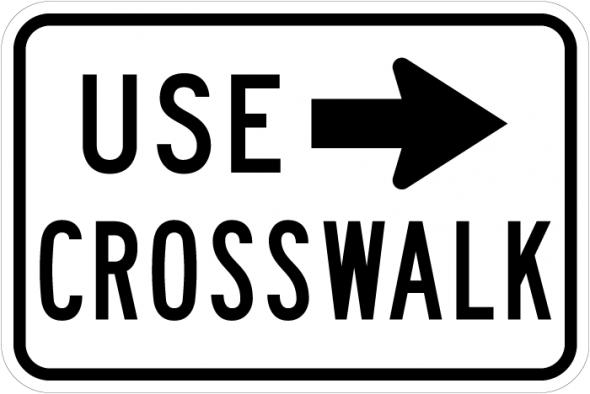 Regulatory Signs / Pedestrian Signs
Use Crosswalk (Plaque) Sign - R9-3b
$21.95 - $92.50
Shop on Trafficsigns.comOutfit Your Crossing With MUTCD-Compliant Pedestrian Signage
Whether you're planning a new pedestrian hybrid beacon, upgrading an existing crosswalk, or supplementing an RRFB installation, Trafficsigns.com carries the regulatory and warning signs municipalities and property managers rely on. Browse the full lineup of pedestrian safety signage or check out a pre-bundled crosswalk signage package to simplify your order.
Shop Pedestrian Safety Signs