
Understand the purpose, types, and placement of guide signs according to MUTCD standards
Common Questions About Guide Signs
- What does a guide sign mean?
- A guide sign provides road users with directional, navigational, or informational guidance. These signs tell drivers where they are, how far they are from a destination, which route to take, and where nearby services or points of interest are located. They do not regulate behavior or warn of hazards; instead, they support confident, informed travel decisions.
- What is the difference between a regulatory sign and a guide sign?
- Regulatory signs communicate legal requirements, such as speed limits, turn restrictions, or right-of-way rules. Drivers are legally obligated to comply with regulatory signs. Guide signs, on the other hand, provide navigation and informational support. They help drivers reach their destinations but do not impose legal obligations. Regulatory signs are typically white with black or red text, while guide signs are most commonly green, brown, or blue.
- What color are guide signs in Virginia (and most U.S. states)?
- In Virginia and across the United States, the color of a guide sign depends on its specific function. Green guide signs are used for general highway directional information, including route numbers and destinations. Brown guide signs indicate recreational areas, parks, and cultural interest sites. Blue guide signs point drivers toward services such as hospitals, gas stations, food, and lodging. White guide signs are used for certain specific purposes such as reference markers.
- What are the three types of guide signs?
- The three primary types of guide signs are: (1) highway guide signs, which include route markers, interchange signs, and destination signs used on freeways and expressways; (2) conventional road guide signs, which include street name signs and directional signs used on local and arterial roads; and (3) recreational and cultural interest area signs, which guide travelers to parks, historic sites, campgrounds, and points of interest. Each category follows specific MUTCD color and design standards.
- What is the shape of a guide sign?
- Most guide signs are rectangular, though there are exceptions. Route marker signs take on specific shapes depending on the highway type, such as the shield shape for U.S. routes, the circle for state routes in some states, and the pentagon for county routes. Recreational guide signs are rectangular with brown backgrounds. The rectangular format allows for longer text and directional arrows while remaining clearly readable at highway speeds.
- Are guide signs required to meet MUTCD standards?
- Yes. All publicly installed guide signs in the United States must conform to the Manual on Uniform Traffic Control Devices (MUTCD). This includes requirements for retroreflective sheeting, color, font, size, and placement. Signs must use specific retroreflective grades such as Engineer Grade, High Intensity, or Diamond Grade depending on the road classification and speed limit of the location.
What Is a Guide Sign?
Types of Guide Signs and Where They Are Used
Green guide signs are the most widely recognized type. They appear on freeways, expressways, and conventional highways to identify destinations, distances, and exit information. Overhead green signs at interchange ramps are among the most common examples. On conventional roads, green signs are also used for street names, milepost markers, and route confirmations.
Brown guide signs direct travelers to parks, forests, campgrounds, historic districts, museums, and other recreational or cultural destinations. These signs follow MUTCD standards for recreational and cultural interest area signs and may be used on public roads as well as within park or recreation area road networks. Products like the Point of Interest Sign (RG-160 and RS-080A) fall into this category and are used to guide visitors toward specific facilities or activities within a broader recreational area.
Blue guide signs identify services available to motorists, including fuel, food, lodging, hospitals, and rest areas. These are especially common along interstate highways and are often accompanied by specific brand logos on official service signs.
Certain guide signs use white backgrounds. These include reference location signs (mileposts), civic and community wayfinding signs, and some informational plaques. County route markers and some local guide signs also use white or yellow backgrounds depending on the jurisdiction.
Highway Guide Signs: Requirements and Standards
Guide Signs vs. Informational Signs: Is There a Difference?
Guide Signs vs. Regulatory Signs vs. Warning Signs
All three major sign categories serve distinct functions on public roads. The table below outlines the key differences in purpose, color, shape, and compliance requirements.
| Attribute | Guide Signs | Regulatory Signs | Warning Signs |
|---|---|---|---|
| Primary Purpose | Navigation, direction, and location of services | Communicate legal requirements and restrictions | Alert drivers to road hazards and conditions |
| Common Colors | Green, brown, blue, white | White, red, black | Yellow, orange (construction) |
| Typical Shape | Rectangular (route markers vary) | Rectangular, octagon (stop), triangle (yield) | Diamond, pennant, rectangular |
| MUTCD Category | Part 2D | Part 2B | Part 2C |
| Legal Obligation | None; informational only | Yes; violations are enforceable | No; advisory by nature |
| Retroreflectivity Required | Yes; grade depends on road class | Yes; grade depends on road class | Yes; grade depends on road class |
| Example Signs | Destination signs, route markers, point of interest signs | Speed limit signs, turn restriction signs | Curve ahead, railroad crossing, school zone |
Guide Signs and Related Traffic Signs Available at Trafficsigns.com
The products below represent guide signs and complementary traffic signs that meet DOT and MUTCD standards. All are constructed from retroreflective aluminum with prepunched holes for straightforward installation.

 Guide Signs / Recreation Signs
Point of Interest Signs - RS-080A
From $34.15
Shop on Trafficsigns.com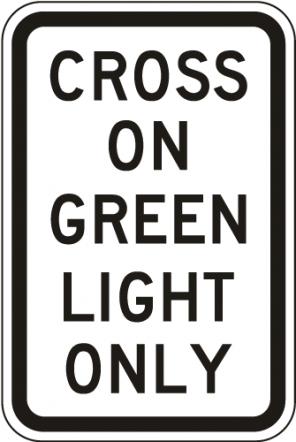 Regulatory Signs / Pedestrian Signs
Cross On Green Light Only Sign - R10-1
From $21.95
Shop on Trafficsigns.com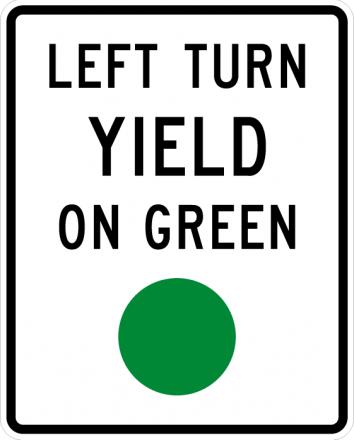 Regulatory Signs / Pedestrian Signs
Left Turn Yield On Green Sign - R10-12
From $57.95
Shop on Trafficsigns.com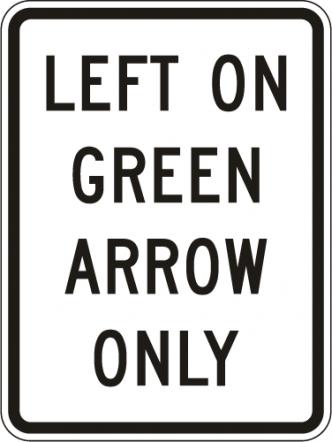 Regulatory Signs / Pedestrian Signs
Left On Green Arrow Only Sign - R10-5
From $33.25
Shop on Trafficsigns.comShop MUTCD-Compliant Guide Signs and Traffic Signs
Trafficsigns.com carries a full range of guide signs, regulatory signs, and warning signs manufactured to meet DOT and MUTCD standards. All signs are available in Engineer Grade, High Intensity, and Diamond Grade retroreflective sheeting, with volume pricing on qualifying orders. Browse the full catalog or contact our team for help selecting the right signs for your project.
Browse Guide Signs