
Understanding W1-1 and W1-2 warning signs and why the distinction matters for road safety
At a glance, a curve traffic sign and a turn traffic sign look almost identical: both are yellow diamonds with a bent black arrow. But the MUTCD treats them as two separate warning signs, and the choice between them comes down to one number: the advisory speed for the curve ahead. This guide breaks down the curve sign vs turn sign comparison so fleet managers, municipalities, and contractors can order the correct sign the first time.
Common Questions About Curve and Turn Warning Signs
- What is the difference between a turn and a curve on a traffic sign?
- Under the MUTCD, the choice comes down to the advisory speed, not the angle of the bend. A curve sign (W1-2) is the default sign for a curve in the road, and a turn sign (W1-1) should be used instead when the recommended safe speed for that curve is 30 mph or less. The arrow on a turn sign is bent more sharply than the arrow on a curve sign, which signals to drivers that they need to slow down more.
- What does the curve sign mean?
- The curve warning sign (W1-2) tells drivers that the road ahead bends in one direction, either left or right, and that they should reduce speed and adjust their path accordingly. It is a yellow diamond warning sign, not a regulatory sign, so it advises rather than mandates a specific action. When an Advisory Speed plaque (W13-1P) is mounted below it, the plaque shows the recommended safe speed for the curve.
- What is the difference between a right turn sign and a right curve sign?
- Both signs point right, but they're used for different advisory speeds. The right turn sign has a sharper, right-angle arrow and is used when the safe speed through the bend is 30 mph or less, which is common where a road makes an abrupt jog. The right curve sign has a smoother, more rounded arrow and is used when the safe speed is higher. Choosing the wrong one can under-communicate how sharply drivers need to slow down.
- What are the main types of signs used on public roads?
- The main categories of traffic signs in the MUTCD are regulatory signs (which set legal requirements like stop or speed limit), warning signs (which alert drivers to hazards or changing road conditions, including curve and turn signs), and guide signs (which provide directional and destination information). Signs used in construction and maintenance work zones are mostly orange versions of these same categories. There are also specialized groups, such as school, railroad, and bicycle signs.
- What materials and reflective grades are available for curve and turn signs?
- Curve and turn warning signs are available on aluminum standard punched blanks in three reflective grades: engineer grade, high intensity, and diamond grade. Because these signs are yellow, the MUTCD doesn't allow engineer grade on them for public roads, so choose high intensity for better nighttime visibility or diamond grade for maximum visibility on high-speed or rural roads.
- How much do curve and turn signs cost, and is there a bulk discount?
- Pricing depends on size and reflective grade. On public roads, the MUTCD's standard size for curve and turn signs is 30 x 30 inches on single-lane roads and 36 x 36 inches on multi-lane roads and expressways. A 30 inch high intensity Curve Advisory Speed Right Sign - W1-2aR is $87.95, while 48 inch signs run up to approximately $256.95. Most signs offer tiered pricing at 4, 7, 16, and 50 unit quantities, so ordering multiple signs for a road project lowers the per-unit cost.
- How are curve and turn signs typically mounted and cared for once installed?
- These signs come with standard punched holes for mounting to U-channel posts or existing sign poles using bolts or bands. Because they are reflective aluminum, they resist rust and fading, but routine cleaning with mild soap and water helps maintain reflectivity. Signs should be inspected periodically for fading, bending, or bullet damage, especially on rural routes where visibility is critical.
MUTCD Classifications: How W1-1 Turn Signs and W1-2 Curve Signs Differ
The Manual on Uniform Traffic Control Devices (MUTCD) groups turn and curve signs with the other horizontal alignment warning signs. A curve sign, coded W1-2, is the default sign in advance of a curve. A turn sign, coded W1-1, should be used instead when the curve's advisory speed (the recommended safe speed through it) is 30 mph or less, which is why turn signs often show up where a road makes an abrupt jog. Where two bends in opposite directions are less than 600 feet apart, a Reverse Turn (W1-3) or Reverse Curve (W1-4) sign replaces the separate signs, and a Winding Road (W1-5) sign can be used where there are three or more changes in direction.
Both signs share the same yellow diamond shape and black border required for warning signs, but the arrow within each sign is drawn differently. Turn sign arrows show a tighter bend to communicate urgency, while curve sign arrows show a smoother curve that matches the actual geometry of the road ahead. You can compare both directly with the curve right warning sign (W1-2R), the curve left warning sign (W1-2L), or the advisory speed versions like the turn with advisory speed left sign (W1-1AL) and turn with advisory speed right sign (W1-1AR).
Getting this classification right matters beyond aesthetics. Traffic engineers use ball-bank indicators and speed studies to set the advisory speed, which determines whether a bend gets a curve or a turn sign, and posting the wrong sign can either under-warn drivers approaching a sharp bend or over-warn them on a gentle one, both of which reduce driver trust in signage over time. Whether a curve sign is required, recommended, or optional depends on the type of road, its traffic volume, and how much lower the advisory speed is than the speed limit, so check with your state DOT or local agency for the requirements on your road.
Beyond the Basics: Related Curve and Turn Warning Signs
Curve and turn signs rarely stand alone in real-world applications. Engineers frequently pair them with advisory speed plaques, or combine them with additional warning elements when a curve intersects a side road or crosses another route. The horizontal alignment and intersection combination signs (W1-10 family) address these more complex scenarios, such as the curve left with side road sign (W1-10BL) or the curve right with cross road sign (W1-10AR), which alert drivers to a curve and an intersecting roadway at the same time.
Advisory speed plaques are another critical companion. The Advisory Speed plaque (W13-1P) mounts below either a curve or a turn sign to show the recommended safe speed, which is especially useful on ramps, exits, and mountain switchbacks. Combination signs like the Curve with Advisory Speed (W1-2a) and Turn with Advisory Speed (W1-1a) build that speed into the sign itself. Related conditions such as reverse turns, winding roads, double curves, and hairpin curves use their own dedicated MUTCD codes, but all fall under the same horizontal alignment sign family and follow the same reflective sheeting and sizing standards. For a full lineup of curve, turn, and combination warning signs, browse the curve and turn signs category.
Curve Sign vs Turn Sign: Side-by-Side Comparison
Use this comparison to quickly identify which horizontal alignment sign fits your road condition, along with the advisory speed pairing typically recommended for each.
| Sign Type | MUTCD Code | When to Use | Advisory Speed Pairing | Typical Application |
|---|---|---|---|---|
Turn Sign | W1-1 | Curve with an advisory speed of 30 mph or less | W13-1P advisory speed plaque | Abrupt jogs and sharp bends on rural roads |
Curve Sign | W1-2 | Curve with an advisory speed above 30 mph (the default sign) | W13-1P advisory speed plaque | Highway curves, mountain roads, long ramps |
Turn with Advisory Speed | W1-1a | Same as a turn sign, with the safe speed shown on the sign | Built into the sign | Sharp turns on rural routes |
Curve with Advisory Speed | W1-2a | Same as a curve sign, with the safe speed shown on the sign | Built into the sign | Ramps, rural highways, reduced-visibility curves |
Horizontal Alignment/Intersection Combination | W1-10 series | Curve or turn combined with an intersecting road | Optional W13-1P plaque | Curves near side roads or cross streets |
Shop Curve and Turn Warning Signs
All signs below are reflective aluminum on standard punched blanks. For curve and turn signs on public roads, choose high intensity or diamond grade, since the MUTCD doesn't allow engineer grade on yellow warning signs.
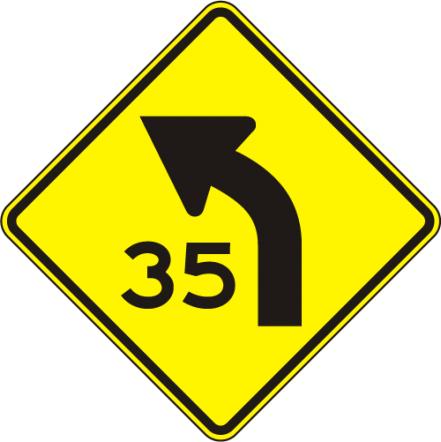 Curve Warning Sign
Curve Advisory Speed Left Sign - W1-2AL
$69.95 - $256.95
Shop on Trafficsigns.com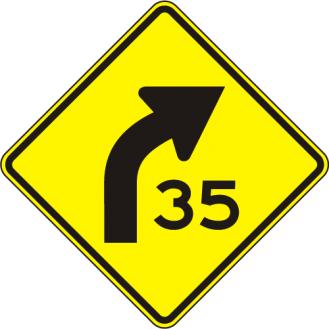 Curve Warning Sign
Curve Advisory Speed Right Sign - W1-2aR
$44.25 - $256.95
Shop on Trafficsigns.com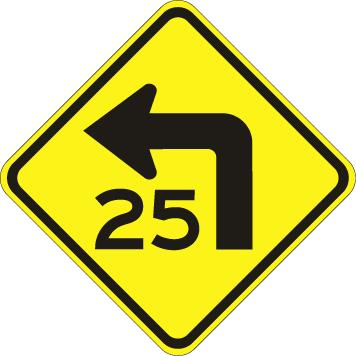 Turn Warning Sign
Turn With Advisory Speed Left Sign - W1-1AL
$44.25 - $256.95
Shop on Trafficsigns.com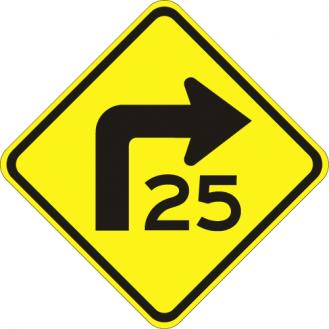 Turn Warning Sign
Turn with Advisory Speed Right Sign - W1-1aR
$44.25 - $256.95
Shop on Trafficsigns.com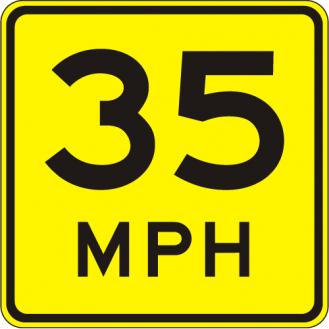 Advisory Speed Plaque
 - W13-1P
Mounts below a curve or turn sign
$36.15 - $148.50
Shop on Trafficsigns.comOrder the Correct Curve or Turn Sign for Your Road
Whether you need a W1-1 turn sign for a sharp bend, a W1-2 curve sign for a gentler one, or a combination horizontal alignment sign for a curve near an intersection, our full lineup is built on reflective aluminum and ready to ship in the size and grade your project requires.