
A closer look at W14-1 and W14-2 road termination signs and when each one applies
Both signs warn drivers that a road doesn't connect through to another street, but they describe two different layouts. A dead end sign marks a road that simply stops, while a no outlet sign marks a street network with multiple branches, none of which lead back out. Knowing the difference matters for HOAs, developers, and municipalities that need to install the correct MUTCD-compliant sign for their road layout.
Common Questions About No Outlet and Dead End Signs
- What does a street sign that says no outlet mean?
- A no outlet sign (MUTCD code W14-2) tells drivers that the street ahead does not connect to another through street. A no outlet road may still branch into several side streets, cul-de-sacs, or looped sections, but none of those branches lead back out to a different road. Drivers who enter will eventually need to turn around and exit the way they came in.
- Is a no outlet sign a warning sign?
- Yes. The W14-2 no outlet sign is classified as a warning sign under the MUTCD, which is why it uses the standard yellow diamond shape rather than a white rectangular regulatory sign. It alerts drivers in advance so they can choose a different route before committing to the street, rather than restricting movement outright.
- What does a dead end sign mean?
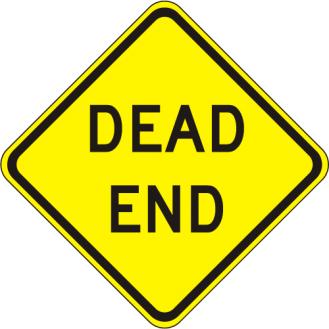
- A dead end sign (W14-1) tells drivers that the road terminates completely with no further path forward and no side streets branching off. The road simply stops, often at a barrier, cul-de-sac, or open field. It marks a single, continuous roadway that ends abruptly rather than a network of connected segments.
- What does it mean when someone says they have no outlet?
- In everyday conversation, people sometimes borrow the traffic sign meaning to describe a street, neighborhood, or situation with no way through to another route. On the road specifically, the term refers to a street layout where none of the connecting branches lead to another thoroughfare, which is exactly what the W14-2 sign communicates to drivers.
- Which sign should I install, no outlet or dead end?
- Base your choice on the actual road layout. If the street stops completely with no branches, install a dead end sign such as the Dead End Warning Sign W14-1. If the street splits into multiple dead-end branches, cul-de-sacs, or loops that never reconnect to another through street, use a No Outlet Warning Sign W14-2 instead. The MUTCD lists both signs as optional, but picking the wrong one can confuse drivers. Post the sign as close as practical to the street's entrance, or far enough ahead that drivers can turn off at the nearest cross street instead.
- Do these signs need to meet MUTCD standards on private roads?
- It depends on whether the public can drive on the road. The MUTCD applies to traffic signs on public roads and on private roads open to the public, such as roads in shopping centers, office parks, and many subdivisions, and the property owner is responsible for installing them to MUTCD standards. Private roads closed to the public at all times by gates or guards fall outside the MUTCD's definition, but some states and HOAs still require MUTCD-style signs, so check with your state DOT or local agency. All dead end and no outlet signs sold here are made on reflective aluminum to meet MUTCD shape, color, and retroreflectivity requirements.
- What sizes and reflective grades are available for these signs?
- Under the MUTCD, Dead End (W14-1) and No Outlet (W14-2) signs are 30 x 30 inches on single-lane conventional roads and 36 x 36 inches on multi-lane roads, and 36 x 36 is required on multi-lane roads posted above 35 mph. The 24 x 24 inch minimum size may only be used on low-speed roads, alleys, private roads open to the public, and low-volume rural roads at 30 mph or less. The matching arrow signs (W14-1a and W14-2a) are 36 x 9 inches. Because these are yellow warning signs, they need high intensity (very reflective) or diamond grade (ultra reflective) sheeting; the MUTCD doesn't allow engineer grade on yellow signs.
Understanding W14-1 and W14-2 Road Termination Signs
Choosing Between a No Outlet Sign, Dead End Sign, or Street Name Sign
No Outlet Sign vs Dead End Sign: Side-by-Side Comparison
| Feature | Dead End Sign (W14-1) | No Outlet Sign (W14-2) |
|---|---|---|
MUTCD Classification | Warning sign, yellow diamond | Warning sign, yellow diamond |
Road Layout Meaning | Road ends completely with no branches or connections | Road splits into branches, cul-de-sacs, or loops, but none lead to a through street |
Arrow Signs (used with a street name sign) | W14-1a, left or right (sold as Dead End Left W14-1AL / Right W14-1AR), 36" x 9" | W14-2a, left or right (sold as No Outlet Left W14-2AL / Right W14-2AR), 36" x 9" |
Standard Sizes | 30" x 30" (single-lane), 36" x 36" (multi-lane); 24" x 24" only on low-speed roads, alleys, private roads open to the public, and low-volume rural roads | 30" x 30" (single-lane), 36" x 36" (multi-lane); 24" x 24" only on low-speed roads, alleys, private roads open to the public, and low-volume rural roads |
Material Grades | High intensity or diamond grade reflective aluminum (engineer grade isn't permitted on yellow signs) | High intensity or diamond grade reflective aluminum (engineer grade isn't permitted on yellow signs) |
Pricing | Varies by size and sheeting grade | Varies by size and sheeting grade |
Best Placement | Entrance of a single road that terminates outright | Entrance of a neighborhood with multiple non-connecting branches |
Shop Dead End and No Outlet Signs
 Warning Signs > Road Condition Signs
Dead End Warning Sign - W14-1
$34.15 - $256.95
Shop on Trafficsigns.com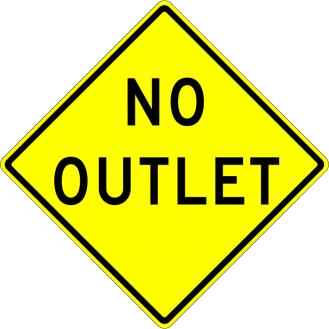 Warning Signs > Road Condition Signs
No Outlet Warning Sign - W14-2
$44.25 - $195.50
Shop on Trafficsigns.com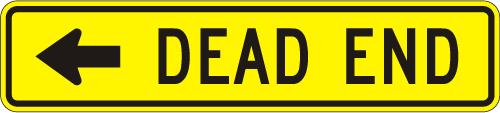 Warning Signs > Road Condition Signs
Dead End Left (Plaque) - W14-1AL
$22.10 - $49.35
Shop on Trafficsigns.com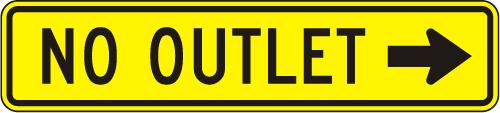 Warning Signs > Road Condition Signs
No Outlet Right Sign - W14-2AR
$22.10 - $49.35
Shop on Trafficsigns.com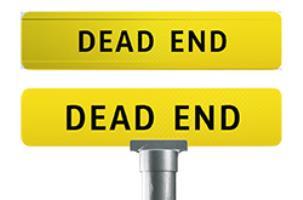 Guide Signs > Street Name Signs
Dead End Street Sign - Extruded & Flat - DENs
$21.95 - $101.85
Shop on Trafficsigns.comOrder the Right Road Termination Sign for Your Property
Whether your street ends completely or branches into a no outlet network, we manufacture MUTCD-compliant signs on reflective aluminum with the sizes and reflective grades your municipality or HOA requires. Browse the full lineup of dead end signs, no outlet signs, and matching directional plaques and get your order in production quickly.
Shop Road Signs