
Understanding the design logic behind traffic sign words, road sign symbols, and MUTCD standards
Not every message on the road can be reduced to a picture. While symbols dominate modern traffic sign design, plenty of regulatory signs, warning signs, and guide signs still rely on plain text to communicate instructions that a symbol simply cannot convey with the same precision. This guide breaks down when traffic engineers choose words over symbols, how MUTCD traffic signs balance both approaches, and what that means for anyone ordering signage for a road, parking lot, or private property.
Common Questions About Word-Based Traffic Signs
- What is the actual difference between traffic sign words and traffic sign symbols?
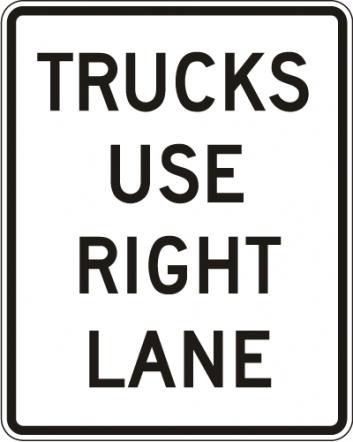
- Symbol signs use pictograms (like an arrow, a merging line, or a pedestrian icon) to convey a message instantly, without language. Word-based signs spell out the instruction directly, such as 'Do Not Pass' or 'Trucks Use Right Lane.' Symbols work best for universal, split-second recognition. Words work best when a message is specific, conditional, or has no widely agreed-upon symbol, such as jurisdictional restrictions or multi-part instructions.
- Are word-only signs still compliant with MUTCD traffic signs standards?
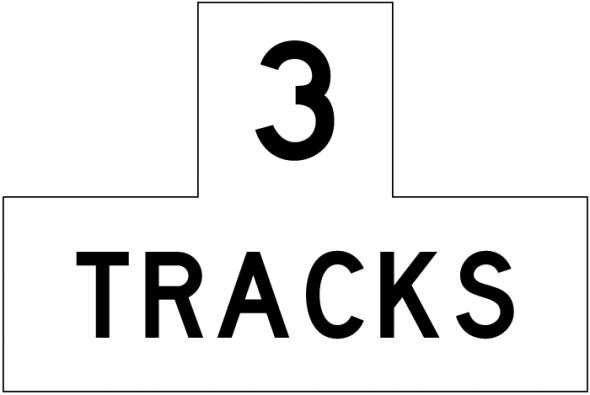
- Yes. The Manual on Uniform Traffic Control Devices allows for text-only, symbol-only, and combination signs depending on the message type. Products like the Do Not Pass Sign - R4-1 pair a symbol with limited text, while others like the Number of Tracks Sign - R15-2p rely entirely on text because the message (number of tracks) has no standardized pictogram. All signs sold on Trafficsigns.com meet DOT and MUTCD state and federal requirements.
- What sizes are available for word-based regulatory signs?
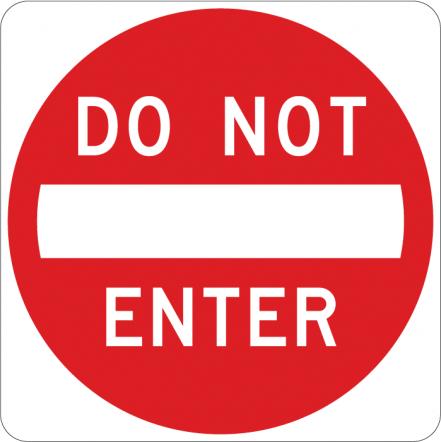
- Sizing depends on the specific sign. Smaller regulatory plaques like the Do Not Enter Sign - R5-1 start at 12" x 12" and scale up to 48" x 48" for high-speed roadways. Larger rectangular signs, such as the Trucks Use Right Lane Sign - R4-5, run from 24" x 30" up to 36" x 48". Larger sizes are generally required on higher-speed roads where drivers need more distance to read and react to text.
- Which material and reflective grade should I choose for outdoor durability?
- All signs are produced on reflective sheeting applied to aluminum, available in Engineer Grade (standard reflective), High Intensity (very reflective), or Diamond Grade (ultra reflective for high-speed or high-risk locations). Engineer Grade suits low-traffic private roads and parking areas, while High Intensity or Diamond Grade is recommended for municipal roads, intersections, and highway-adjacent installations where nighttime visibility is critical.
- Can I get custom wording on a traffic sign, or only standard MUTCD text?
- Standard MUTCD-coded signs (R-series, W-series) come with fixed, federally recognized wording to ensure legal compliance and driver recognition. If you need custom language for a private road, campus, or facility, look at our custom regulatory signs options, which allow adjusted wording while keeping the reflective materials and construction quality of standard signage.
- How does pricing scale with quantity for word-based traffic signs?
- Most signs include volume pricing tiers. For example, the Do Not Enter Sign - R5-1 starts at $19.05 in Engineer Grade at 12" x 12", with per-unit price dropping at 4, 7, 16, and 50-unit thresholds. Larger municipal or highway orders benefit the most from these tiers, since price per sign decreases as quantity increases across all three reflective grades.
- How are these signs installed once they arrive?
- All signs ship with standard 3/8" prepunched mounting holes and radius corners, so they install directly onto U-channel posts, square tube, or existing sign hardware using standard bolts. No specialty tools are required. For parking lots or facility entrances, pair signage with post hardware sized to the sign dimensions and mounting height requirements for your location.
How Traffic Engineers Decide Between Words and Symbols
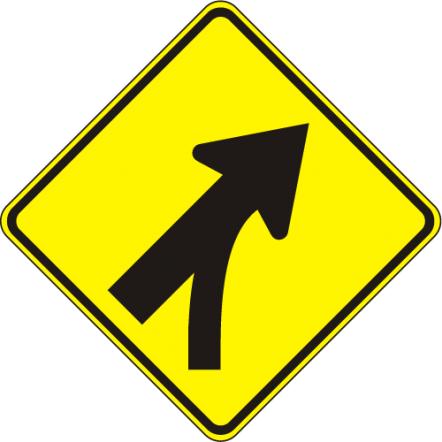
Traffic sign design isn't arbitrary. Engineers follow decades of research on driver recognition and sign comprehension to determine whether a message should be conveyed through road sign symbols, traffic sign words, or a combination of both. Symbols excel when a message needs to be understood instantly, regardless of language or reading speed. A merge symbol, a curve arrow, or a pedestrian icon can be processed in a fraction of a second, which matters enormously at highway speeds.
Words take over when a message is too specific, conditional, or regionally variable for a universal symbol to exist. Consider the Do Not Pass Stopped Train Sign - R15-5a or the Do Not Pass Light Rail Transit Sign - R15-5. There is no globally recognized pictogram for 'stopped train' or 'light rail vehicle,' so text becomes the clearest way to prevent driver confusion. Similarly, parking regulation signs like the Do Not Park In Front Of Dumpster Sign - AR-122 communicate a narrow, situational restriction that a symbol alone could never capture accurately.
Regulatory signs, warning signs, and guide signs each lean on this word-versus-symbol decision differently. Regulatory signs (found in our traffic control signs category) frequently combine both, using a symbol for quick recognition and text underneath for legal clarity. Warning signs, such as those in our road condition signs lineup, tend to favor symbols because drivers need to react before they have time to read. Guide signs, by contrast, often rely heavily on words because destinations, distances, and route numbers cannot be represented with icons.
Where Word-Based Signs Still Outperform Symbols
Despite the industry-wide push toward international symbols and standardized pictograms, plenty of situations still call for plain language. Multi-part instructions are the clearest example. A sign that says 'Trucks Use Right Lane' communicates a specific behavioral rule that applies only to certain vehicle types, something a single icon struggles to express without additional text. The same logic applies to signs like 'Do Not Drive On Tracks' or 'Do Not Enter,' where the consequence of misreading a symbol could be severe.
Word-based signs are useful when there isn’t a standard symbol for a specific rule or restriction. Property managers, municipalities, and facility owners often need signs for situations that aren’t covered by MUTCD symbols. That’s why our municipal and private road sign collections include both standard symbol signs and signs with clear, written instructions.
Highway and intersection environments still favor symbols for split-second recognition, which is why our highway warning signs and intersection warning signs categories lean heavily on pictograms like merge arrows and curve indicators. The right choice always comes down to how much time a driver has to process the message and how specific that message needs to be.
Word-Based Signs vs Symbol-Based Signs: Quick Comparison
Here's how word-based and symbol-based traffic signs compare across the factors that matter most to drivers and traffic engineers.
| Sign Type | Recognition Speed | Best Use Case | Example Sign | Typical Category |
|---|---|---|---|---|
| Symbol-only | Fastest (near-instant) | High-speed roads, split-second reactions | Entering Roadway Merge Sign - W4-5 | Warning Signs |
| Word-only | Slower, requires reading time | Specific or conditional instructions with no standard icon | Number of Tracks Sign - R15-2p | Regulatory Signs |
| Combination (symbol + words) | Fast recognition with added clarity | Legal instructions needing both speed and precision | Do Not Enter Sign - R5-1 | Regulatory Signs |
| Word-heavy guide text | Moderate, depends on message length | Destinations, distances, route information | Guide sign panels | Guide Signs |
Word-Based and Symbol-Based Signs Worth Comparing
These signs illustrate how traffic sign words and road sign symbols work together across regulatory, warning, and parking applications. Each is built on reflective aluminum and available in Engineer Grade, High Intensity, or Diamond Grade for different visibility needs.
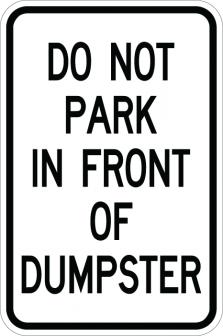 Parking Signs
Do Not Park In Front Of Dumpster Sign - AR-122
$21.95 - $25.95
Shop on Trafficsigns.comFind the Right Sign for Your Message
Whether your project calls for a symbol-driven warning sign, a precise word-based regulatory sign, or a combination of both, Trafficsigns.com stocks MUTCD-compliant options in Engineer Grade, High Intensity, and Diamond Grade reflective sheeting. Browse our full range of regulatory signage to find the exact wording and visibility level your roadway or property needs.