
Everything you need to know about yield sign color, size, placement, and legal requirements under MUTCD standards
Common Buyer Questions About Yield Signs
- What sizes are available for yield signs, and which size do I need?
- Standard yield signs are available in 24x24 inch, 30x30 inch, and 36x36 inch formats. The MUTCD recommends a minimum 30-inch size for most roadway applications, with 36 inches required on high-speed or high-volume roads. For private property, parking lots, and low-speed applications, the 24-inch size is commonly used. Always verify local jurisdiction requirements before selecting a size.
- What reflective grade should I order for a yield sign?
- Engineer Grade reflective sheeting meets baseline visibility requirements and works well for low-speed, low-traffic environments. High Intensity Grade provides significantly greater nighttime visibility and is suitable for most public roadway applications. Diamond Grade offers the highest retroreflectivity and is specified for high-speed roads, highways, and locations where maximum visibility is critical. All three grades are available at Trafficsigns.com and meet DOT and MUTCD standards.
- Do yield signs from Trafficsigns.com meet federal and state standards?
- Yes. All High Intensity and Diamond Grade signs sold at Trafficsigns.com meet DOT and MUTCD state and federal standards. Signs are printed on reflective aluminum standard punched blanks, making them compliant for both public roadway and private property installation.
- Are bulk pricing discounts available for yield sign orders?
- Yes. Volume pricing tiers apply starting at 4 units, with additional breaks at 7, 16, and 50 units. For example, an Engineer Grade sign priced at a base rate receives progressively lower per-unit pricing at each quantity threshold. This is ideal for municipalities, traffic control contractors, and property management companies ordering for multiple locations.
- What material are the yield signs made from?
- Yield signs are constructed on aluminum standard punched blanks with a reflective sheeting surface. The aluminum substrate is weather-resistant and designed for long-term outdoor installation. The reflective face is applied at the sheeting grade you select: Engineer Grade, High Intensity, or Diamond Grade.
- How are the signs mounted, and do they come with pre-drilled holes?
- Signs come on standard punched blanks, meaning they include pre-punched mounting holes compatible with standard sign posts, U-channel posts, and square tube posts. No additional drilling is required for typical installations.
- What is the turnaround and shipping time for yield signs?
- Production and shipping times vary depending on order size and configuration. Standard in-stock regulatory signs typically ship quickly. For specific lead times on your order, contact Trafficsigns.com directly or check product pages for current availability and estimated ship dates.
What Are the Rules of a Yield Sign?
The critical distinction in yield sign rules is that yielding does not always require a full stop. If the intersection is clear and there is no conflicting traffic or pedestrians present, a driver may proceed through at reduced speed without stopping. This is the fundamental difference between a yield sign and a stop sign. A stop sign requires a complete stop regardless of conditions. A yield sign requires a stop only when conditions demand it.
Right of way at a yield sign belongs to the traffic on the roadway being entered. Cross traffic, pedestrians in crosswalks, cyclists, and vehicles already in a roundabout all have priority over the driver facing the yield sign. Failure to yield when required constitutes a traffic violation in every U.S. state.
A common question is whether yield signs follow a two-second or three-second rule. There is no formal gap-timing rule codified specifically for yield signs. The standard guidance is that a driver must leave sufficient distance and time for safe entry, meaning the gap in traffic must be long enough for the yielding driver to merge or cross without forcing other road users to brake or swerve. The two-second and three-second following distance rules apply to safe following distances while driving, not to yield sign gap judgment.
Yield Sign Color: What the Red and White Design Means
Historically, yield signs in the U.S. were yellow with black text. The yellow yield sign was used from the sign's introduction in the 1950s through the early 1970s. The federal standard transitioned to the red-and-white design starting in 1971, with full implementation required by 1974. Yellow yield signs installed under the old standard were grandfathered for a period but are no longer in compliance. Any sign you see today referencing a yellow yield sign reflects either the old standard, a non-MUTCD-compliant installation, or a sign used in another country.
The red-and-white yield sign color was adopted to align the U.S. with international standards and to increase the sign's visual authority, associating it more closely with the red of stop signs than with the yellow of warning signs. This is also the clearest answer to whether a yield sign is a warning sign: it is not. Yellow is reserved for warning signs in the MUTCD system. Red regulatory signs, including stop signs and yield signs, communicate legal obligations rather than hazard advisories.
Yield Sign Dimensions and Shape Specifications
- 30 inches on each side: The standard minimum for most public roads and the most commonly installed size.
- 36 inches on each side: Required on expressways, high-speed arterials, and locations with elevated traffic volumes or poor sight distance.
When to Use a Yield Sign: Placement and Applications
Yield signs are appropriate when:
- Sight distance is adequate for drivers to judge gaps in traffic without a mandatory stop. Locations with poor sight distance, sharp curves, or obscured approaches typically require a stop sign instead.
- Traffic volumes on the major road are low enough that requiring a full stop on the minor road would create unnecessary delay without meaningful safety benefit.
- A merging movement is involved, such as a freeway on-ramp or a two-lane road merging into a higher-volume road.
- Roundabout or traffic circle entries require entering vehicles to give way to circulating traffic.
- Pedestrian crossings or shared paths require cyclists or drivers to give priority to pedestrians without a full stop being warranted.
- Multi-way intersections have a clear hierarchy where one approach has priority, but full stop control is not justified by traffic volume or crash history.
Yield signs are also used in conjunction with other regulatory signs. For example, the R1-2a To Oncoming Traffic plaque is used alongside yield-related signing at intersections where a specific traffic movement must yield to an opposing flow. Similarly, the R10-16 U-Turn Yield to Right Turn sign addresses specific conflict points where u-turning vehicles must yield to right-turning traffic.
Using a yield sign where a stop sign is warranted, or omitting traffic control where yield control is needed, creates conditions for preventable crashes. Consulting the MUTCD and your state's supplement, or working with a licensed traffic engineer, is advisable for public roadway applications.
Yield Sign Reflective Grade Comparison
Choosing the right reflective grade for a yield sign depends on road speed, traffic volume, ambient lighting, and regulatory requirements. The table below compares the three grades available from Trafficsigns.com.
| Feature | Engineer Grade | High Intensity Grade | Diamond Grade |
|---|---|---|---|
| Reflectivity Level | Standard retroreflective | Very high retroreflective | Ultra-high retroreflective |
| Typical Application | Private roads, parking lots, low-speed secondary streets | Most public roadways, urban and suburban arterials | High-speed roads, expressways, freeway ramps |
| MUTCD Compliance | Meets baseline standards | Meets DOT and MUTCD standards | Meets DOT and MUTCD standards |
| Nighttime Visibility | Good | Very Good | Excellent |
| Relative Cost | Lowest | Mid-range | Highest |
| Material Base | Reflective aluminum blank | Reflective aluminum blank | Reflective aluminum blank |
| Outdoor Durability | Long-lasting | Long-lasting | Long-lasting |
Yield and Right-of-Way Signs for Every Application
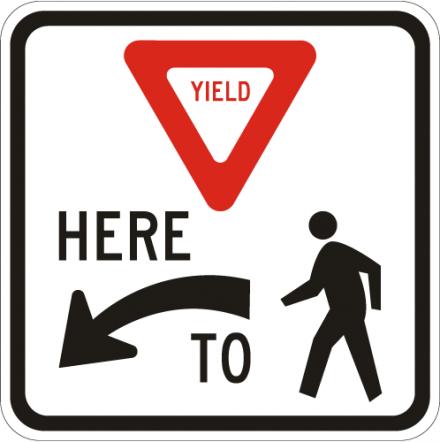 Regulatory Signs / Stop & Yield Signs
Yield to Pedestrians Here Left Sign - R1-5L
$34.15 - $148.50
Shop on Trafficsigns.com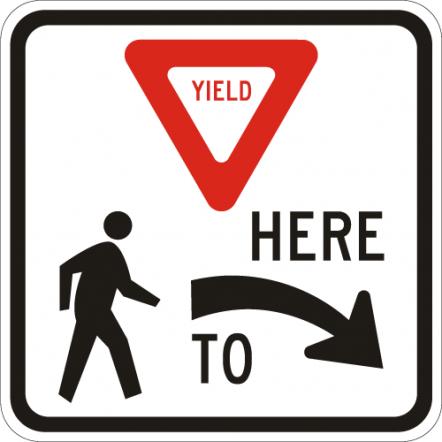 Regulatory Signs / Stop & Yield Signs
Yield to Pedestrians Here Right Sign - R1-5R
$34.15 - $148.50
Shop on Trafficsigns.com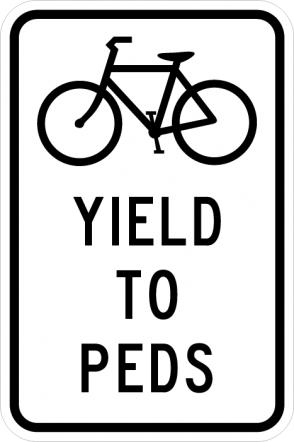 Regulatory Signs / Pedestrian Signs
Bikes Yield to Peds Sign - R9-6
$21.95 - $58.25
Shop on Trafficsigns.com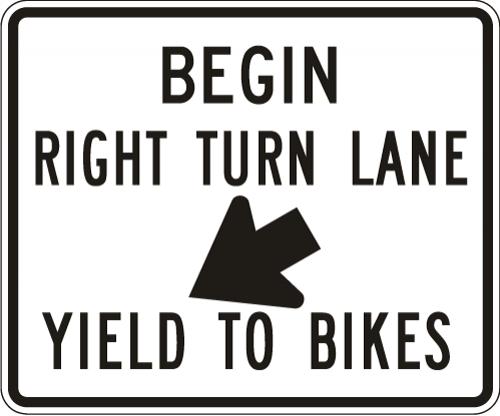 Regulatory Signs / Traffic Control Signs
Right Turn Lane Yield to Bikes - R4-4
$33.25 - $123.75
Shop on Trafficsigns.com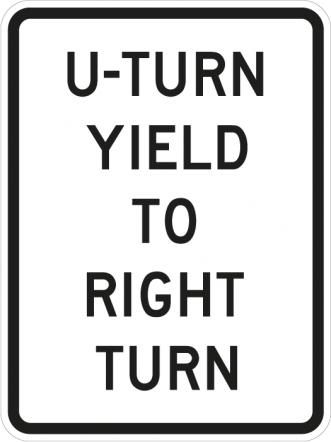 Regulatory Signs / Pedestrian Signs
U-Turn Yield To Right Turn Sign - R10-16
$57.95 - $123.75
Shop on Trafficsigns.com
Order MUTCD-Compliant Yield Signs from Trafficsigns.com
Trafficsigns.com supplies regulatory yield signs and right-of-way signing for municipalities, traffic engineers, property managers, and contractors. All signs are manufactured on reflective aluminum standard punched blanks and are available in Engineer Grade, High Intensity, and Diamond Grade sheeting to match your specific application and budget. Volume pricing is available starting at 4 units, with additional breaks at 7, 16, and 50 units.
Shop Regulatory Signs