
Understanding the federal standards behind every legal stop sign
Every stop sign installed on a public roadway has to meet specific federal guidelines before it can legally direct traffic. The Manual on Uniform Traffic Control Devices (MUTCD) sets the rules for shape, color, size, retroreflectivity, and placement that make a stop sign enforceable and recognizable to drivers nationwide. Whether you're a municipality replacing worn signage, a property manager installing signs on private roads open to the public, or a contractor outfitting a new development, knowing the stop sign MUTCD requirements protects you from liability and keeps intersections safe. This guide breaks down exactly what an MUTCD compliant stop sign needs, from sheeting grade to mounting height, so you can order with confidence.
Stop Sign Buying Questions, Answered
- What size stop sign is required for MUTCD compliance?
- On public roads, the MUTCD calls for a STOP sign of at least 30 x 30 inches on single-lane conventional roads, and 36 x 36 inches on multi-lane roads and expressways. Even on low-volume, low-speed roads, the minimum is 30 x 30. Smaller 18 and 24 inch STOP signs are best kept to private parking lots and driveways. When ordering, match the size to the road rather than defaulting to the smallest or cheapest option, and check with your state DOT or local agency for any local requirements.
- What sheeting material makes a stop sign MUTCD compliant?
- A compliant stop sign must use retroreflective sheeting that meets minimum ASTM D4956 brightness levels. Engineer grade sheeting satisfies the baseline requirement for low-traffic streets, while high intensity and diamond grade sheeting provide significantly better nighttime visibility and are preferred for busier intersections and higher-speed roads. Our STOP signs come in High Intensity and Diamond Grade. Non-reflective material is never compliant for roadway installation.
- Can I use a 4-WAY plaque, and does the ALL-WAY plaque need to match the stop sign's sheeting grade?
- No. The MUTCD doesn't allow plaques like 2-WAY, 3-WAY, or 4-WAY under a STOP sign. At an intersection where every approach has a STOP sign, an ALL-WAY plaque with a white legend on a red background must be mounted below each STOP sign. The MUTCD doesn't require the plaque to match the STOP sign's sheeting grade, but using the same grade keeps the whole assembly looking consistent at night.
- How much does a compliant stop sign cost?
- Pricing depends on size and sheeting grade. The Stop Signs - R1-1 start at $31.50 for an 18 inch High Intensity sign, a 30 inch High Intensity sign (the standard public-road size) is $57.90, and a 36 inch Diamond Grade sign runs about $121.90 before volume discounts. Most stop sign products offer tiered pricing, so ordering 4, 7, 16, or 50 units at once lowers the per-sign cost.
- How long does production and shipping take?
- In-stock aluminum signs in standard sizes typically ship within a few business days. Larger quantities or custom orders may take longer, so if you're working against an installation deadline, it's worth confirming production time before you order.
- How should a compliant stop sign be mounted?
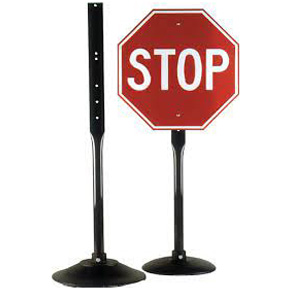
- Stop signs must be mounted so the bottom edge sits at least 7 feet above the pavement in areas with pedestrian traffic, or at least 5 feet in rural settings without sidewalks. A sturdy post and base, such as a pedestal base and standard, keeps the sign rigid and at proper height, which matters just as much as the sign face itself for compliance.
- Can I get bulk pricing for multiple stop signs?
- Most regulatory signs on our site include quantity break pricing built into the listing, with discounts kicking in at 4, 7, 16, and 50 units. If you're covering an entire subdivision or municipal route, ordering STOP signs together with ALL-WAY plaques and mounting hardware can reduce your overall cost per intersection.
What Does MUTCD Compliance Mean for Stop Signs?
A mutcd compliant stop sign is one that meets the design, material, and placement standards published in the federal Manual on Uniform Traffic Control Devices. These standards exist so that a stop sign in one state looks and functions exactly the same as one in another, giving drivers a consistent, instantly recognizable warning no matter where they are. Compliance isn't optional for public roadways. Agencies that install non-conforming signage can face liability exposure if an accident occurs at a poorly marked intersection, and insurance claims often hinge on whether signage met the applicable code at the time of installation. For a deeper look at how these rules developed over time, see our post on the history of stop signs, and for a broader overview of where and how stop signs are used, check out stop sign requirements and uses.
Stop Sign MUTCD Requirements: Shape, Color, and Size
The octagon shape is reserved exclusively for stop signs under the MUTCD, which is why drivers can identify a stop sign from behind or through fog even when the text isn't legible. The background must be red with a white legend and border, using the standard red and white set by FHWA's sign color specifications to maintain uniformity. On size, the MUTCD calls for a STOP sign of at least 30 x 30 inches on single-lane conventional roads and 36 x 36 inches on multi-lane roads and expressways, and the minimum stays at 30 x 30 even on low-volume, low-speed roads. Smaller 18 and 24 inch versions are best kept to private parking lots and driveways. The MUTCD also doesn't allow extra wording on the STOP sign face itself. At all-way stops, the only plaque that goes below it is the ALL-WAY plaque, since 2-WAY, 3-WAY, and 4-WAY plaques aren't allowed. Letter height, border width, and corner radius are also specified precisely, which is why STOP signs and ALL-WAY plaques are manufactured to exact dimensional tolerances rather than approximated by hand.
MUTCD Stop Sign Specifications for Retroreflective Sheeting
Retroreflectivity is where many non-compliant signs fail, even when the shape and color look correct. The MUTCD requires a minimum retroreflectivity level measured in candelas per lux per square meter, and agencies are expected to maintain or replace signs once they fall below that threshold due to sun exposure and age. Engineer grade sheeting meets the baseline standard and works well for low-speed residential streets. High intensity sheeting roughly doubles the reflective performance and is a common choice for collector roads and municipal intersections. Diamond grade sheeting delivers the brightest, farthest-visible reflection and is typically specified for state highways, high-speed corridors, and locations with a documented history of nighttime crashes. Advance warning signs that work alongside stop signs, such as the Stop Ahead (Symbol) Sign - W3-1, are yellow, and the MUTCD doesn't allow Engineer Grade on yellow signs, so choose High Intensity or Diamond Grade for those to keep the entire approach to the intersection consistently visible.
Common Questions About Stop Sign Classification and Related Signs
Stop signs fall under the regulatory sign category in the MUTCD, not the warning or guide categories. Regulatory signs tell drivers what they must or must not do, and a stop sign's command to come to a complete stop makes it one of the clearest examples of that category, officially designated R1-1. Warning signs, by comparison, use a yellow diamond shape to alert drivers to upcoming conditions, which is why a sign like Cross Traffic Does Not Stop carries a W-series code instead of an R-series one. On shape, the answer is consistently the octagon, the only eight-sided sign shape used in the MUTCD system specifically so stop signs remain identifiable from any angle. The Do Not Enter sign carries the code R5-1 and shows a white horizontal bar on a red circle inside a square white sign. As for the most essential signs drivers encounter, the commonly cited top road signs typically include Stop, Yield, Speed Limit, Do Not Enter, One Way, No Left/Right Turn, Railroad Crossing, School Zone, Pedestrian Crossing, and Merge, since these cover the core regulatory and warning information needed for safe everyday driving.
Comparing Sheeting Grades for Compliant Stop Sign Standards
Sheeting grade is the single biggest factor separating a minimally compliant stop sign from one built for maximum nighttime visibility. Use this comparison to match the right grade to your road type and budget.
| Sheeting Grade | Retroreflectivity Level | Typical Application | Relative Cost | MUTCD Compliant for Roadway Use |
|---|---|---|---|---|
| Engineer Grade | Meets minimum federal retroreflectivity standard | Low-speed residential streets, private roads | $ | Yes, meets minimum requirement |
| High Intensity | Roughly double the brightness of engineer grade | Municipal streets, collector roads, moderate traffic intersections | $$ | Yes, exceeds minimum requirement |
| Diamond Grade | Highest available retroreflectivity, visible from the farthest distance | State highways, high-speed corridors, high-crash intersections | $$$ | Yes, exceeds requirement by the widest margin |
| Non-Reflective | No retroreflective coating | Temporary indoor displays, training materials only | $ | No, not permitted for roadway installation |
Compliant Stop Signs and Supporting Hardware
These products cover the core components of a compliant stop sign installation, from the STOP sign and ALL-WAY plaque to advance warning signs, mounting hardware, and protective covers.
 Regulatory Signs
Stop Signs - R1-1
30" or 36" for public roads; 18" and 24" for private lots
$31.50 - $121.90
Shop on Trafficsigns.com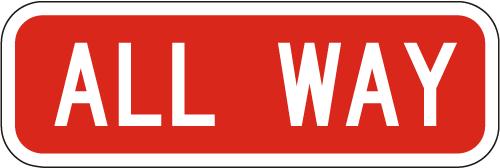

Order MUTCD Compliant Stop Signs Today
Don't risk liability with outdated or non-conforming signage. Browse our full selection of regulatory stop signs, supplemental plaques, and mounting hardware built to meet current MUTCD stop sign specifications and keep your intersections safe and compliant.
Shop Regulatory Signs